
3. (用幻灯片出示习题,巩固2a和2b内容。)
T: We have reviewed 2a and 2b. Let’s do some exercises.
(1)-Lily doesn’t like my song.
- does Lucy.
A. Neither B. So C. Either
(2)-I like go shopping.
- do I and does Jane.
A. Neither, so B. So, so C. So, neither
(3) the bad weather, we can’t go shopping.
A. Because of B. Thanks to C. Unless
(4)Two sixths of the students girls in our class.
A. be B. are C. is
(5)用ever, never, just, already和yet填空。
-Have you been to America?
-No, but Tom has returned from New York. He has seen many places of interest, but he hasn’t been to London . He says he has been to any city in England.
Step 5 Project 第五步 综合探究活动(时间:5分钟)
2. (教师播放录音2a与2b,学生跟读。)
(让学生看着2b中的8个句子重新造句。)
T: We have learnt the useful expressions in Topic 2. Please make up sentences with them as quickly as you can.
S1: -I really hate to go shopping.
-So do I.
S2: -It is a nice picture.
-So it is.
S3: About one fifth students in our class ride bikes to school.
S4: …
(学生们有不同的句子,修正它们,培养他们的表达能力。)
1. T: Fairmont is a beautiful mountain town. Beijing is a beautiful city. Where have you been?
S1:I have never been to Fairmont. But I have ever been to Beijing.
(教师重复读never been to, ever been to。)
T: I went to Beijing three years ago. But I believe that great changes have already taken place
in Beijing these years. My husband has gone to Beijing now.
(教师重复读have already taken place, has gone to。)
(举两个例子巩固been to 与gone to区别。)
|
He has
gone to Beijing. I have been to Beijing. |
(让学生自己造句子。)
For example:(1) Li Ming has gone to the library. He will be back soon.
(2) Sue has been to Germany. She wants to go there again.
3. (教师出示幻灯片,让学生思考并复述1a。)
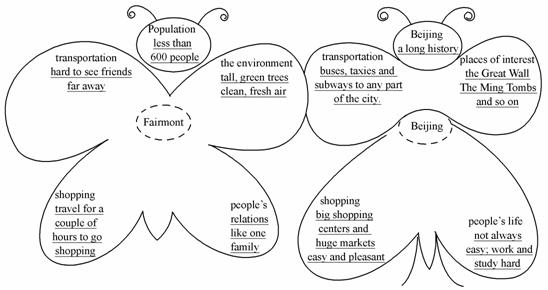
T: Now, I’ll give you two minutes to read the information on the slides and then retell it with the key words on them.
(几组同学复述之后,教师点评。)
T: Boys and girls, if you are allowed to choose the place where you live, do you want to live in a place with a large population or a small one? I think you have different choices.
Step 4 Practice 第四步 练习(时间:10分钟)
2. (读1a,完成表格,完成1b。)
T: Read 1a, fill out the form and finish 1b.
|
Items |
Population |
Environment |
Shopping |
Transportation |
People’s relations |
|
Sue’s / Fairmont |
|
|
|
|
|
|
Li Ming’s / Beijing |
|
|
|
|
|
1. (听1a录音,然后回答问题。)
T: Living in the country has lots of advantages, so does living in the city. Listen to 1a and answer my questions.
(出示问题)
(1)Where do Sue and Li Ming live?
(2)What are the differences between Sue’s life and Li Ming’s life?
(3)How do they feel about their living conditions?
(听后核对答案。)
1. T: Do you like living in a place with a large population or a small one?
Ss: A small one. What about you?
T: Me, too. I used to live in a small village which had less than 200 people. It had lots of tall, green trees and clean, fresh air. People’s relations were very harmonious. My village was like a big family.
(板书less than, relation,要求学生掌握。)
|
less than, relation |
Ss: But was it easy for you to go shopping?
T: No, the only shortcoming was that I couldn’t go shopping in big stores unless I travelled for a couple of hours.
(板书单词unless,词组a couple of,且要求学生掌握。)
|
unless, a couple of |
S1: I heard life in the city were colourful.
T: Right. There are many big shopping centers and huge markets. Shopping is easy and pleasant there. And the public transportation is excellent, too. Buses, taxies and subways can take you to any part of the city quickly.
(板书market和excellent,且要求学生掌握。要求学生了解transportation。)
|
market, excellent |
Ss: Great! We want to live in the city now.
T: You’re so changeable. But life isn’t always easy there. People have to study and work hard to keep up with the quick development of modern society.
(板书且要求学生掌握。)
|
keep up with |
Step 3 Consolidation 第三步 巩固(时间:8分钟)
2. T: What difficulties does the large population cause in the composition?
S1: Small places to live in.
S2: Heavy traffic.
S3: Short of energy and water.
…
Step 2 Presentation 第二步 呈现(时间:12分钟)
(就学生习作中人口和生活质量问题展开讨论,引出城乡对比。)
Step 1 Review 第一步 复习(时间:10分钟)
1. (教师在实物投影仪上展示Section C中3的学生习作,复习上节课内容。)
China has the largest population in the world. There are about 900 million people living in the countryside. The large population causes many problems today.
For example, we are short of energy and water. Most of the cities are more crowded than before, and the traffic is much heavier. The large population has become a serious problem. Some parents in less developed areas prefer boys to girls. So they don’t offer girls a good education. In order to give people comfortable lives, China has taken some measures to control the population. One is known as the one-child policy. Thanks to the policy, China is developing quickly, and people’s living conditions are improving rapidly. Our lives are becoming more and more comfortable.
幻灯片/录音机/3中的三幅图片
湖北省互联网违法和不良信息举报平台 | 网上有害信息举报专区 | 电信诈骗举报专区 | 涉历史虚无主义有害信息举报专区 | 涉企侵权举报专区
违法和不良信息举报电话:027-86699610 举报邮箱:58377363@163.com