
Ⅱ. 1. C 2. B 3. A 4. B 5. A
Ⅰ. 1. how to get to 2. watching…also seeing 3. are showing interest in 4. to learn the …of 5. both kind and
Ⅴ. 1. looking 2. Sorry 3. way 4. along 5. take 6. right 7. bridge 8. left 9. end 10. hospital
提高能力测试
Ⅳ.
1. B is are 2. A didwas doing 3. C betterbest 4. A WhatWhat a 5. C thatwhat
Ⅲ. 1. be used, use 2. grow, is grown 3. were bought, bought 4. were washed, washed 5. remembered, were remembered
Ⅱ. 1. A 2. A 3. B 4. B 5. C 6. C 7. D 8. D 9. A 10. B
Ⅰ. 1. hang 2. journey 3. foreign 4. heart 5. money 6. music 7. buy 8. stamp
Ⅴ.书面表达
根据文字提示以“做一个可爱的中国人”为话题,写一篇词数不少于60字的短文。
1.Why should we be lovely Chinese?
2.What should or shouldn’t a lovely Chinese do?
3.How are you going to be a lovely Chinese?
[同步达纲练习]
巩固基础训练
Ⅲ.完型填空
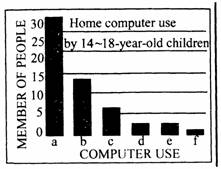
Look at the diagram. It 1 something of home computers used by a group of young people.
We asked thirty young people 2 fourteen and eighteen. We asked them how much 3 they usually spent on their computers in a week, but we 4 most interested in 5 they used their computers for.
The usual time spent on a computer in a week was about twelve hours, with 6 user about thirty-two hours, and the lowest user only five hours.
All the children said they usually used computers 7 . Fourteen children told us they did some wordprocessing(文字处理) 8 . Only two of them said computers 9 their lessons, and eight people told us they kept addresses and phone numbers on their computers or used 10 as diaries. Only three people said they were learning to make computer programmes and nobody looked up databases(数据库).None of them used computers for any 11 use.
The 12 show that computer use is quite high among 14-18 years old. They also show quite clearly that computers 13 by most young people as little more than game machines. The only other great uses are for word-processing and keeping address lists. 14 , though computers are common in the homes of young people, they have not yet become 15 in everyday life.
|
( )1.A.shows |
B.says |
C.writes |
D.gives |
|
( )2.A.among |
B.between |
C.from |
D.about |
|
( )3.A.hours |
B.money |
C.time |
D./ |
|
( )4.A.is |
B.was |
C.are |
D.were |
|
( )5.A.what |
B.why |
C.how |
D.whether |
|
( )6.A.high |
B.higher |
C.the higher |
D.the highest |
|
( )7.A.to read |
B.reading |
C.to play games |
D.playing games |
|
( )8.A.at times |
B.as usual |
C.in the end |
D.all the time |
|
( )9.A.found out |
B.worked at |
C.helped with |
D.looked over |
|
( )10.A.theirs |
B.them |
C.its |
D.it |
|
( )11.A.another |
B.other |
C.the other |
D.others |
|
( )12.A.ways |
B.questions |
C.reports |
D.results |
|
( )13.A.are seen |
B.have seen |
C.will be seen |
D.see |
|
( )14.A.More or less |
B.From now on |
C.By the way |
D.It seems to us that |
|
( )15.A.wonderful |
B.popular |
C.useful |
D.expensive |
湖北省互联网违法和不良信息举报平台 | 网上有害信息举报专区 | 电信诈骗举报专区 | 涉历史虚无主义有害信息举报专区 | 涉企侵权举报专区
违法和不良信息举报电话:027-86699610 举报邮箱:58377363@163.com