
2. A projector
1. A sample version
1. Practice method
2. Improve students’ ability of writing.
1. Improve students’ ability of reading comprehension.
Practice reading and writing using the target language.
3. Moral Object
Volunteering is good experience for future jobs. If conditions permit, encourage students to be a volunteer.
2. Ability Objects
(1) Improve students’ ability of reading comprehension.
(2) Improve students’ ability of writing.
1. Knowledge Objects
(1) Key Vocabulary
the other day, concentrate, learn from, at present, volunteer, local
(2)Target Language
What school rules do you think should be changed?
Well, I think we should be allowed to wear our own clothes.
What’s the reason?
We would feel more comfortable and
that is good for studying.
Members should be allowed to use dictionaries.
Yes, but they should only use English-English dictionaries.
Step Ⅰ Revision
(1)Check the homework.
(2) Competition: Write "are allowed to" and "aren’t allowed to" on the blackboard, Divide the class into groups.
Each group is asked to write down as many things as they can think of about what teenagers are or aren’t allowed to do. See which group can think of the most items for each category.
Step Ⅱ 1a
This activity reviews the use of always, sometimes, usually and never.
Point to the picture. Ask students to describe what is happening in the picture.
Help students to say, The boy is late for class. Invite a student to read the four questions in the box to the class.
Read the instructions and remind students of the exact meanings of the adverbs of frequency.
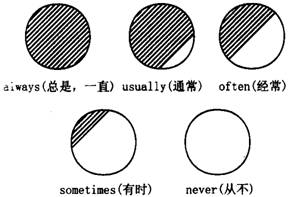
Say, Please write A after things you always do, U after things you usually do, S
after things you sometimes do and N for things you never do.
Get students to finish the task on their own.
Answers to this activity will vary.
Step Ⅲ lb
This activity provides oral practice using the target language.
Point out the sample conversation. Ask a pair of students to say it to the class.
SA: Do you ever get to class late?
SB: Yes, I sometimes get to class late.
Say, Talk with your partner about your answers in Activity 1a.
As the pairs work together, walk around the room offering help if necessary.
Ask several pairs to share their conversations with the class.
Step Ⅳ 2a
This activity provides practice in understanding the target language in spoken conversation.
Point out the four items in Activity 1a.
Say, You will listen to a conversation and circle the things on the list that you hear.
Play the recording for the first time.
Students only listen.
Play the recording a second time. This time students listen and circle the things that they hear.
Check the answers.
Answers
Circled items: 1,4
Step Ⅴ 2b
This activity provides listening practice using the target language.
Point to both the numbered and lettered lists of item in the box.
Point out the sample answer. Read the sentence "Peter is going to fail a math test to the class."
Say, I’ll play the same recording again.
You are to match the sentence parts as you hear on the tape.
Play the recording for students to do the activity.
Check the answers.
Step Ⅵ 2c
This activity provides oral practice using the target language.
Call students’ attention to the statements in the box. Say them to the class.
Ask three students to read the sample conversation to the class, completing the sentences.
SA:I think Peter should be allowed to take the test later.
SB:I don’t agree.
SC:I think the school has to have rules.
Write the conversation on the blackboard.
Divide the class into groups of four. Say,
Now discuss the statements with your group.
As the groups work together, walk around the room offering help as needed.
Ask some groups to say a few lines of their conversations to the class.
Notes
Parents should not be too strict with teenagers. Note the word be strict with.
Generally speaking, we say be strict with sb. but be strict in sth. For example, Our teachers are strict with us. He is strict in his work.
Step Ⅶ Summary and Homework
Say, In this class, we’ve learned to talk about agreement and disagreement. And we’ve also reviewed adverbs of frequency. Have you ever been late for school?
Write a passage to describe what was happening that day.
Step Ⅷ Blackboard Design
|
Unit 3 Teenagers should be
allowed to choose their own clothes. Section B The Fourth Period Target language: A: I think Peter should be allowed to take the test later. B: I don’t agree. C: I think the school has to have rules. |
The Fifth Period
湖北省互联网违法和不良信息举报平台 | 网上有害信息举报专区 | 电信诈骗举报专区 | 涉历史虚无主义有害信息举报专区 | 涉企侵权举报专区
违法和不良信息举报电话:027-86699610 举报邮箱:58377363@163.com