
1. (呈现1a。)
T: You’ve talked much about TV programs and your preference. Now, let’s learn what Kangkang and his friends like to watch. Listen to the tape and answer the questions:
(板书,让学生根据问题听对话。)
|
(1)
What does Michael want Kangkang to do? (2) Why does Maria like watching TV shows? (3) What do Michael and Kangkang think of watching TV shows? |
T: Now listen to the tape carefully!
(播放录音磁带。)
T: Could you answer the questions on the blackboard? Any volunteers?
OK, S1, please! Question 1.
S1: Michael wants Kangkang to teach him to play Chinese chess.
T: Great. S2, please answer Question 2.
S2: Because she thinks TV shows are wonderful and she can learn a lot from them.
T: You are wonderful!S3, could you give the answer to Question 3?
S3: OK. They are very boring.
T: Very good.
(让学生读1a,根据所提问题进一步理解对话内容。)
T: Now, let’s turn to 1a on page 25 and read through the dialog.
(2分钟后)
T: Finished?
Ss: Yes.
T: S4, could you tell me how Maria and Michael express their preference?
S4: Maria likes watching TV, and Michael would rather watch sports shows.
2. (结对讨论学生喜爱看什么电视节目,并给出原因。)
T: We’ve discussed some TV programs. Now, let’s discuss what programs would you like to watch. You’d better give your reasons. Work in pairs, and I’ll see which pair is the best. Let’s begin!
(让学生进行结对练习。)
T: Stop here. S8 and S9, please show us your job.
(这两名学生表演对话。)
S8: Which program do you prefer, TV plays or sports shows?
S9: I would rather watch TV plays than sports shows because TV plays are more interesting.
How about you?
S8: I would rather watch news reports because I can learn a lot of things at home and abroad from it.
T: What do you think of their job?
Ss: Good!
Step2 Presentation 第二步 呈 现(时间:10分钟)
呈现1a,通过回答问题加深对对话内容的理解。
Step 1 Review 第一步 复 习(时间:15分钟)
复习上一单元的功能话题。再由图片导入新词并介绍电视节目名称。
1. (简要复习上一单元的功能话题,导入新学内容,激活学生的思维,让学生进入英语学
习状态。)
T: Nice to see you again.
Ss: Nice to see you, too.
T: Could you tell me what you usually do in your spare time?
S1: I like watching TV.
S2: I like reading books.
T: What kind of books would you like to read?
S2: Humous story books and history books.
T: You are all great. Indeed, reading is a good habit. And also some students like playing Chinese chess.
(鼓励学生开展健康的课外活动,建立和谐民主的师生关系。)
T: There are so many students who enjoy playing chess. Who is the best player in our class?
Ss: S3.
T: S3, could you teach us how to play Chinese chess?
S3: Of course.
T: Thank you. This is a set of Chinese chess. Now it belongs to you.
[教师张贴李瑞英、王小丫、金龟子(刘纯燕)的图片在黑板旁。]



T: Some people like Chinese chess and some people like watching TV. There are some pictures on the blackboard. Could you tell me who they are?
Ss: They are Li Ruiying, Wang Xiaoya and Jinguizi.
T: Do you know what programs they host?
Ss: Li Ruiying hosts CCTV news. Jinguizi hosts children’s programs.
T: This is Wang Xiaoya. She is usually in charge of quiz shows.
(导入新短语并板书,解释其意义及用法,领读。)
|
quiz
shows |
T: How many TV programs do you know?
(开展Brainstorming活动,让学生尽量多说出一些电视节目名称。)
S4: TV plays, CCTV news, sports shows ...
T: S4,do you know anything else?
S4: Cartoon, entertainment shows ...
(板书电视节目名称。)
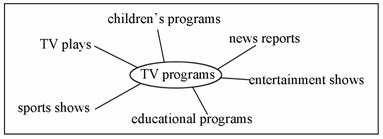
T: Great! How wonderful! There are so many programs. But which one is your favorite, TV plays, cartoon or quiz shows?
S5: I like watching TV plays better than quiz shows.
T: I see. S5 says he/she would rather watch TV plays than quiz shows. What about you, S6?
S6: I would rather watch CCTV news. But I don’t like sports shows.
T: S6 says he/she likes watching CCTV news. But he would rather not watch sport shows. How about you, S7?
S7: I would rather not watch TV. I like surfing on Internet.
T: S7 says he would rather surf on Internet than watch TV.
(板书本课中出现的重难点句式,让学生弄清其句式结构,为下一步教学活动扫除障碍。)
|
She
would rather watch TV plays than quiz shows. →would
rather do sth. than sth. He would rather not watch sports shows. →would rather not do sth. He would rather surf on Internet than watch TV. →would rather do sth. than do sth. |
录音机/李瑞英、王小丫、刘纯燕等一些节目主持人的图片/一盒象棋/《泰坦尼克号》主题曲磁带
5. Preference and hobbies
I would rather watch TV plays than sports shows.
4. Broaden the students’ horizons.
3. Learn how to talk about TV programs.
2. Review v.-ing used as object.
(1)In my spare time, I enjoy watching TV, especially quiz shows from which I can learn a lot.
(2)I’m tired of watching those shows.
(3)I like watching soccer games best.
1. Master some new phrases:
would rather ...than ..., fall in love (with sb.)
2. Homework
电视节目设计方案:
(1)节目名称: Talks on Different Cultures(不同文化访谈)
(2)节目风格(style)
(3)表现形式(form)
(4)选择收集的信息内容(information)
信息内容: ①交际话题的差异
②对不同事物的情感态度
③一些有哲理的谚语
④不同的风土人情
湖北省互联网违法和不良信息举报平台 | 网上有害信息举报专区 | 电信诈骗举报专区 | 涉历史虚无主义有害信息举报专区 | 涉企侵权举报专区
违法和不良信息举报电话:027-86699610 举报邮箱:58377363@163.com