
2.Learn the simple present tense:
They usually have lunch at school.
What do you usually do after school?
Do you often read books in the library?
-How often do you go to the library?
-Once/Twice/Three times a week/Very often/Every day/Seldom…
1.(1) Learn adverbs of frequency:
once, twice
(2) Learn other new words:
today, life, American, break, finish, basketball, read, clean, house, dance,
library, week, every, must, first, listen, music
4. Homework:
(1)(让学生用Section A和Section B中学过的重点句型写一篇五句话左右的有关自己的小短文。如果有兴趣,学生们可以课外收集中外古谚语,名人名言。培养他们的自主学习能力和自我建构能力。)
(2)(让学生收集有关中美学生学校生活的资料,看他们之间有什么不同,预习第5页的1a。)
Section C
The main activities are 1a, 2 and 3. 本课重点活动是1a, 2和3。
3. (班级活动。让学生完成5。)
T: At last let’s relax. Let’s chant together.
(在轻松活泼融洽的气氛中结束这节课。)
You go to work by bike.
He walks to school with Mike.
She comes here by plane.
They go there by train.
We are busy on weekdays.
Let’s be early as always.
2. (弹性课堂。要求学生背一句谚语。)
(板书)
|
Proverb: Where there is a will, there is a way. 有志者事竟成。 |
1. (1)(让学生调查自己的同伴或邻近的学生,根据调查结果,写一段话,尽量使用频度副词。)
T: Now, look at the table. Please make a survey about your partner or your neighbors. You should fill out the form with the adverbs of frequency. At last, write a short passage according to the form.
(表格如下。)
|
Activity Name |
go shopping |
watch TV in the evening |
walk after supper |
get up early |
|
|
|
|
|
|
|
|
|
|
|
|
|
|
|
|
|
|
|
|
|
|
|
|
(2)(找几名学生,汇报他们的调查结果。)
T: OK. Who wants to share your passage with us?
S1: I do. ×× often goes shopping. ×× always watches TV in the evening.
3. (1)(播放录音,让学生完成4。)
T: Please look at 4. Listen to the tape and choose the correct answers. Do you understand?
Ss: Yes, we do.
T: Good. Let’s begin.
(2)(核对答案。)
T: OK. Let’s check the answers. Are you ready?
Step 5 Project 第五步 综合探究活动(时间:10分钟)
2. (1)(让学生完成3b。)
T: Now, talk about the pictures in 3a with your partner.
For example:
A: How does Maria go home?
B: Maria sometimes goes home by subway. Is that clear? Begin!
(2)(呈现句子的同义替换,加强对乘坐交通工具方式的灵活运用。)
(总结归纳乘坐交通工具的方式并板书。)
|
by subway - take the subway by bike - ride a bike on foot - walk by bus - take a bus by car - take a car by plane - fly |
T: Look at this sentence again: Maria sometimes goes home by subway.
We can also say: Maria sometimes takes the subway home.
But what about these sentences?
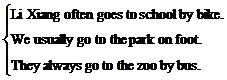
(3)(让学生做上一步的同义替换练习,并核对答案。)
(板书答案。)
|
Li Xiang often rides a bike to school. We usually walk to the park. They always take a bus to the zoo. |
1. (呈现3a的图片,通过师生互动,让学生进一步了解和巩固语言知识。)
(1)T: Look at the first picture. What does Maria do?
Ss: Maria takes the subway.
(通过谈论第2、3、4幅图,可以得到以下几个句子。)
For example:
Li Xiang goes to school by bike.
We go to the park on foot.
They go to the zoo by bus.
(2)(让学生听录音,写句子。)
T: Listen to the tape and write down the sentences you hear on your exercise book.
For example:
Maria sometimes goes home by subway.
Li Xiang often goes to school by bike.
We usually go to the park on foot.
They always go to the zoo by bus.
(3)(核对答案。)
T: Now let’s check the answers together.
5. (让学生利用关键词造句。)
For example:
never: I never go to school on foot.
…
Step 4 Practice 第四步 练习(时间:10分钟)
湖北省互联网违法和不良信息举报平台 | 网上有害信息举报专区 | 电信诈骗举报专区 | 涉历史虚无主义有害信息举报专区 | 涉企侵权举报专区
违法和不良信息举报电话:027-86699610 举报邮箱:58377363@163.com