
8.( ) We often borrow books from this ___________.
7.( ) The people in Wuhan put two beautiful ________ across the Changjiang River.
6.( ) He’s making a call over I ________.
5.( ) It’s too late. We can’t get back. We have to find a _______ to live in.
4.( ) My parents often take a walk in the _________ near our home.
3.( ) We can buy cheap goods(货物,商品)in this __________.
2.( ) Many people in Wuhan enjoy themselves in the ___________ on weekends.
考题1:根据汉语完成下列句子,每空一词。
(1)街上有许多公用电话。
There are many ________ ________ on the streets.
(2)--你购物时,经常刷卡吗?
--不,我没有信用卡。
--When you go shopping, do you usually ________ with your credit card.(信用卡)
--No, I don’t have credit card.
解析:此题主要考查pay作名词和作动词的用法,在第(1)题中pay用作名词,在(2)题中pay用作动词,由上栏可知。
答案:(1)pay phones (2)pay
考题2:根据句意或首字母提示完成句子。
(1)Not many people write with the l________ hand.
(2)Is that the r________ time?
(3)A: Excuse me?
B: Yes?
A: Is there a hospital near here?
B: There’s one near Louis Supermarket.
A: W________ Louis Supermarket?
B: Go down this street, and take the first turning(第一个拐弯处)on the r________, then the second turning on the l________, then turn r________ again.
A: Thank you very much.
解析:此题主要考查right和left的三种用法。根据题意和上栏的讲解可知。
答案:(1)left (2)right (3)Where’s, right, left, right
考题3:根据下图,完成下列各句中所缺的介词。
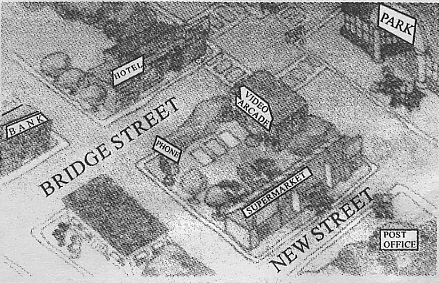
(1)The video arcade is ________ Bridge Street.
(2)The hotel is ________ the supermarket.
(3)The bank is ________ the hotel.
(4)There is a bench ________ the park.
(5)A supermarket is ________ the hotel and the post office.
解析:此题主要考查本课中出现了的几个重要的表示空间关系的方位介词的用法,由上栏和图示可知。
答案:(1)on (2)next to (3)across from
(4)in front of (5)between
考题4:在句子中正确的词下面划线。
(1)Next to the post office (is / are) a small house (has / with) an interesting garden.
(2)(Where’s / where) the park? It’s across from the hotel.
(3)There (is / are) two chairs and a desk in the room.
解析:此题主要是考查主谓一致的问题,由上栏的讲解和题意可知答案为:(1)此句为倒装句,正常的语序为:A small house with an interesting garde is next to the post office。主语house为单数,故用is;(2)Where’s;(3)are。
答案:(1)is with (2)Where’s (3)are
考题5:根据考题3中的图示,回答下列问题。
(1)Is there a video arcade in this neighborhood?
________________________________________________________
(2)Is there a bank on New Street?
________________________________________________________
(3)Where is the supermarket?
________________________________________________________
解析:此题主要考查there be句型的一般疑问及其回答,由上栏的讲解和题意可知。
答案:(1)Yes, there is. (2)No, there isn’t. (3)It’s on New Street.
考题6:根据句意,选择正确的答案完成句子。
(1)The bank is ________ Bridge Street on the right.
A. from B. down C. between D. off
解析:句意:银行在大桥街的右边。down在这里是介词“沿着”。
答案:B
(2)If you go to the New Park, you’ll have to go ________ Center Avenue.
A. across B. pass C. on D. through
解析:go是动词只能与介词搭配,因此此处不能用动词pass。
答案:D
(3)Go ________((直接)/down / straight)to school without shopping.(包头市中考题)
解析:句意:直接去学校不要购物。
答案:straight
考题7:单项选择。
The water is ________.
A. in B. over C. up D. off
解析:句意:自来水停了。由上栏讲解题及题意可知答案为D。
答案:D
考题8:选择括号中的词语完成对话。
--May I come?
-- ________, you can’t come to the video arcade, because you are a student.(Excuse me/ Sorry)
解析:表示委婉拒绝,不同意对方的要求,用sorry。打扰别人,询问情况用Excuse me,故答案为Sorry。
答案:Sorry
考题9:英汉词组互译。
(1)a man with a lot of money(钱)
(2)the beginning of his new life
(3)许多作业要做
(4)桌子上的书
(5)到我家的路(线路)
(6)a good place to have fun
解析:此题主要考查介词短语和动词不定式作后置定语。由上栏及题意可知。
答案:(1)一位很有钱的人 (2)他新生活的开始
(3)a lot of homework to do (4)the book on the desk
(5)the way to my house (6)一个娱乐的好场所
考题10:--How does your mother usually go to work?
--She usually goes to work __________.
A. take taxi B. take a taxi
C. by taxi D. by a taxi
解析:goes to work是动词短语,因此,只能与by taxi搭配,表示“上班”的方式,即go to work by taxi。
答案:C
考题11:根据句意,选择正确的词填空。
(1)Let me tell you the ________ to the airport.(way / road)
(2)Don’t play football on the ________. (street / way)
(3)You go through Sixth ________, Seventh Avenue and Eighth Avenue. (Avenue / street)
解析:此题主要考查词语的辨析,由上栏和题意可知。
答案:(1)way (2)street (3)Avenue
考题12:根据汉语完成句子,每空一词。
(1)火车什么时候到站?
When ________ the train ________ at the station?
(2)她常常到家很晚。
She often ________ ________ very late.
解析:此题主要考查这两组同义词的辨析,(1)does, arrive(at只能与arrive搭配)。(2)gets home与arrives home均可(home是副词,前面不能用介词at或to)。
答案:(1)does, arrive (2)gets home或arrives home
考题13:选择。
(1)There are two bridges ________ the river.
(2)I can see you ________ the window.
A. across B. through C. on D. over
解析:(1)over表示在垂直的正上方。(2)through表示透过玻璃。
答案:(1)D (2)B
[模拟试题](时间:60分钟;满分100分)
I. 词汇语法练习(22分)
A. 根据句意,选择适当的图片,将图片序号填在题前的括号里,将该单词写在句中的横线上。(10分)
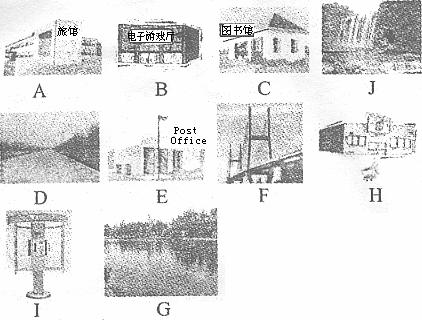
1.( ) If you want to post a letter, you can go to the _________.
16. be busy with sth.与be busy doing sth.等动词短语的用法
enjoy oneself与enjoy doing sth.
have to与must
△be busy with sth.忙于某事
be busy doing sth.忙于干某事
He is busy doing his homework. = He is busy with his homework.
他正忙于作业。
△enjoy oneself = have a good time 过得愉快
玩得高兴have fun也能表达此意。
enjoy doing sth.喜爱干某事
△must与have to都可以表示“必须”。must着重于主观上认为有义务,有必要;而have to 着重于客观上的需要,含有“不得不”的意味。如:
We must work hard.
我们必须努力工作。(是我们要这样做)
We have to work hard.
我们得努力工作。(环境使我们不得不这样做)
15. when / if开头的状语从句及that / where引导的宾语从句
一个完整的句子若充当了另一个句子的某一个成份,这个句子就叫从句,如果充当的是状语,称为状语从句,是宾语就称作宾语从句。本单元出现的从句有:
△if: And if you’re hungry, you can buy some food in the supermarket.
如果你饿了,你可以在超市里买些食品。
if在此句中是连词,意为“如果”用来引导条件状语从句。
△when: When you see a big supermarket, turn left.
当你看到一个大超市时向左拐。
when在此处作连接副词,引导一个时间状语从句,意为“当……的时候”。
△Draw a picture of where your partner lives.
请画一张你同伴居住地方的图画。
介词“of”后面没有直接接一个名词作介词宾语,而是接了一个宾语从句,连接词虽是where,但整个句子仍保持了陈述句的语序。再如:
Ask your partner about where he or she lives.(宾语从句)
向你的同伴询问他或她居住的地方。
Is there a big supermarket near where you live?(宾语从句)
你居住的地方附近有个大超市吗?
I hope you have a good trip.(宾语从句,作动词hope的宾语)
△hope可以接不定式或从句作宾语:hope to do ; hope + 宾语从句
但不能说hope sb. to do sth.。如:
I hope you to go out for a walk with me. (×)
I hope you go out for a walk with me. (√)
我希望你和我一块去散步。
湖北省互联网违法和不良信息举报平台 | 网上有害信息举报专区 | 电信诈骗举报专区 | 涉历史虚无主义有害信息举报专区 | 涉企侵权举报专区
违法和不良信息举报电话:027-86699610 举报邮箱:58377363@163.com