
1. up 2. than 3. rain 4. head, hurts, leg 5. had
Step 7 Language focus
Ask students to look again at the dialogue and underline all the sentences with question mark and the sentences with the five new words.
Step 8 Language focus
Students match the sentences with their definitions (task 4 on the student worksheet);
Feedback as a class.
KEY:1-B 2-H 3-E 4-G 5-K 6-A 7-D 8-C 9-F 10-J 11-H
Step 7 Practice
Students do Task 5 on their worksheets (also available at Activity 4 on Page 49).
KEY:
|
Accident report |
|
|
Where |
along the wall |
|
Who |
Daming |
|
What Happened |
Daming fell over the wall. He cut his knee and there was blood on his leg. He
couldn’t move and walk. |
|
How is the person hurt? |
Not serious |
Step 8 Further practice
Students do Task 6 & Task 7 (also available at Activity 5 & 6 on Page 49).
KEY:Task 6
7. There he is, lying on the ground!
Step 6 Listening (Task 3)
Play the audio of some sentences of the dialogue with some words blank out and have the students put down the missing words.
KEY:
6. I’ll call for help on my mobile.
5. Show me where he is.
4. He’s cut his head; his shoulder hurts and I think he’s broken his leg.
3. He was running along the wall when he tripped and fell over the edge.
2. He has had an accident.
1. It’s Daming.
4. Student worksheets.
|
Level: |
|
Junior Grade Three |
|
Language: |
|
Unit 1 He has had an accident. |
|
Aims: |
|
Listening skills
~Understand the dialogue ; Language skills ~Text reconstruction. Important points: ~New words and phrases & comprehension of the dialogue; Difficult points: ~Talk about similar experience. |
|
Lesson length: |
|
Approximately 45 minutes. |
|
Materials: |
|
Lesson procedures Student worksheet Student’s book 6 |
|
Preparation: |
|
Before the lesson: l Enough copies of the student worksheet; l Enough extra copies of the jumbled dialogue (student worksheet task 1); l Cut the dialogue into strips. l Available the audio for Unit 1. |
|
Teaching
methods: |
|
Communicative approach. |
Teachers' notes: Lesson Procedure

Step 1 Stimulate student interest
Generate interest by showing them the image from Unit 1.
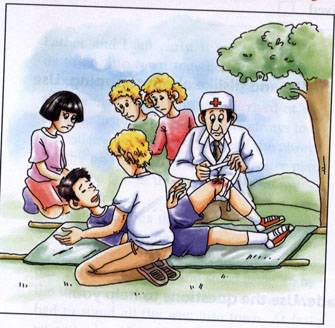
Ask students:
· Who are these people? (Lingling, Tony, Betty, Mr. Jackson, Daming, Bob).
· Where are they? (on the hill.)
· What’s happened?(……)
· Do you think the person is hurt? (……)
· What do you think he has done to himself? (……)
Step 2 Pre-teach essential vocabulary
Write the words on the board, eliciting spelling as you write. Make sure students copy the board work into their notebooks. Model and drill the correct pronunciation of the words: elicit and show the word stress of each item and word class, if appropriate.
|
miss trip fever knee wound |
Ask students to look at the picture on Page 48, and talk about questions in Activity 1 in pairs. Encourage the students to try to use the new vocabulary. Before the students talking about this picture, the teacher can introduce some useful expressions for the students to refer to.
|
1. see+ sb.+doing 2. first aid: 急救 give first aid to sb/give sb first aid: 对人进行急救 3. knock down: 撞倒 4. have a fever: 发烧 5. have a flu: 得了流感 6. have nothing to do with: 与……无关 7. a wound in one knee: 某人 8. bind up: 包扎 |
T: What can you see in the picture?
S: I can see some people.
S: I can see a tree.
S: I can see a doctor.
S: I can see a boy lying on the ground and the doctor is giving first aid to him.
T: Yes, very good. What’s happened to the boy? Do you think he has had flu or a fever? (Speak slowly and put stress on have flu and a fever. If necessary, repeat the sentence again.)
S: Maybe.
S: I don’t think so.
T: Why?
S: Because I see the doctor is binding up the wound. The boy got a wound in his knee. I don’t think the wound has anything to do with flu.
T: What do you think he has done to himself?
S: Maybe he hurt himself while playing basketball.
S: Maybe he was knocked down by a car.
S: Maybe he fell down from the tree when he was trying to pick an apple from the tree.
T: Very good. Do you think the person is hurt?
S: Of course, look, his mouth is widely open; he must be painful.
T: Good. What should you do by meeting such situation?
S: Call 120 as soon as possible.
S: Take the person who is hurt to the hospital.
S: No, you shouldn’t move the person if he is hurt. You should wait for the doctor.
S: You can ask the person who is hurt whether he can move by himself.
T: Good.
Step 3 Pre-listening: prediction
Give out the student cut-up dialogues. Students work in pairs or small groups to order the dialogue.
Step 4 Listening (Activity 3)
Tell students they are going to listen and check their answers. Play the audio (without showing the text).
Play a second time if necessary; check answers as a class. Have students practice the dialogue in groups of 2.
Step 5 Listening (Task 2)
Play the audio of strips of the dialogue and have the students put the words in right order in each sentence.
KEY:
3. Answers.
湖北省互联网违法和不良信息举报平台 | 网上有害信息举报专区 | 电信诈骗举报专区 | 涉历史虚无主义有害信息举报专区 | 涉企侵权举报专区
违法和不良信息举报电话:027-86699610 举报邮箱:58377363@163.com