
1. (出示残疾儿童的图片,指令学生运用现在完成时,针对图片进行问答练习。)
(1)-Have you ever told stories to the kids? -Yes, I have.
(2)-Have you ever fed the disabled children? -No, I haven’t.
(3)I have cleaned their rooms.
3. (学生两人一组,谈论过去的孩子和现在的孩子不同的生活。)
T: Work in pairs to talk about children’s different lives in the past and nowadays.
For example:
S1:In the past, many families were big and poor.
S2:Yes. The parents couldn’t afford their children’s education.
S1:The children had no chance to go to school.
S2:Some of the children had to be child laborers.
S1:I feel sorry for them. We are so happy nowadays.
S2:Nowadays, our country has developed rapidly. Most children can get a good education.
T: Just now, you compared Chinese teenagers’ lives in the past with those nowadays. You can write an article about it after class.
Step 4 Practice 第四步 练习(时间:10分钟)
2. (听录音2c填空。提高学生听力技能,进一步了解过去与现在的生活变化。)
T: Listen to the tape and fill in the blanks.
(播放录音2c两遍,并核对答案。若有不明白之处,再放一遍。)
1. (分角色朗读2a,选择四组进行比赛,激发学生朗读兴趣。)
3. (鼓励学生说出疑难点和含有现在完成时态的句子,引导学生解释疑难点,并板书要点,理解生词support, rapidly,掌握短语in detail。)
|
have/live a hard
life Is that so? in detail can’t/couldn’t afford sth. Our country has developed rapidly. give support to sb./give sb. support |
Step 3 Consolidation 第三步 巩固(时间:12分钟)
2. (学生打开课本,再听2a,跟读并找出疑难点。)
1.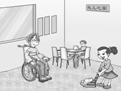 (老师拿出一张残疾儿童之家的图片,导入现在完成时的一般疑问句。)
T: What’s this?
Ss: It’s a disabled children’s home.
(理解单词disabled,板书并领读)
|
disabled |
T: Have you ever been there?
Ss: Yes, we have./No, we haven’t.(引导学生去回答)
T: Maria has been to a disabled children’s home. Do you want to know what Maria has done there?
Ss: Certainly.
T: OK. Let’s listen to the tape and answer the following question. What did she do to help them?
(听1a录音回答问题,老师核对答案。)
T: Did Maria have anytime to travel?
Ss: No, she didn’t. But she still felt happy.
T: Yes. Though she has no time to travel, she learned a lot from her holiday experiences.
(老师解释though引导让步状语从句,不与but连用,然后继续询问。)
T: Sally, what did you do to spend your leisure time during the holiday?
(板书leisure, learn … from …并要求理解)
|
leisure |
Sally: I watched many films.
T: Oh. Do you want to watch films now, boys and girls?
Ss: Great.
(用多媒体播放《三毛流浪记》和《家有儿女》影片片断,对比影片所反映的生活。播放2a录音前,把班级分为A和B两大组,分别记录过去和现在生活,完成2b。)
|
|
Food |
Clothes |
Education |
… |
|
In the past |
|
|
|
|
|
Nowadays |
|
|
|
|
T: Today we all have a happy life, but in the past, people’s lives were very hard. Listen to the tape, and answer the following questions. (播放2a录音,并回答下列问题。用幻灯片出示问题,让学生读问题,并放录音。)
|
1. Did kangkang’s granny
have a hard life in the past? 2. How did most children spend their childhood in the past? |
(板书,理解childhood)
|
childhood |
2. (教师出示一张吉姆的旅游照片,介绍他的假期经历,导入并教授生词。)
T: Do you want to know where Jim has been during his summer holiday?
Ss:Yes.
T: It’s a photo of him. Let me describe it for you.
(板书)
|
describe |
T: He has been to Beijing with his parents, granny and little sister.
(板书)
|
granny |
T: His little sister went there for further education. Her dream is to study abroad. I hope her dream will come true. I think some of you want to study abroad. Am I right?
(板书)
|
education |
Ss:Yes, you’re right.
T: So you must study hard. With the development of our country, most of you will have a chance to study abroad.
(板书,学生跟读熟悉单词,快速记忆。)
|
development, develop |
Jim also did some social activities.(学习social,引入disabled children’s home。)
Step 2 Presentation 第二步 呈现(时间:10分钟)
Step 1 Review 第一步 复习(时间:8分钟)
1. (通过师生问答复习现在完成时。)
T: Hi, Class. Let’s play the game “Quick Response”.
T: Where have you been, S1?
S1: I have been to Hong Kong, and I have bought many things.
.
.
.
T: Where has S2 gone?
S3: He/She has gone to Mr. Lee’s office.
录音机/幻灯片/残疾儿童的照片/小黑板/《三毛流浪记》和《家有儿女》影片片断
湖北省互联网违法和不良信息举报平台 | 网上有害信息举报专区 | 电信诈骗举报专区 | 涉历史虚无主义有害信息举报专区 | 涉企侵权举报专区
违法和不良信息举报电话:027-86699610 举报邮箱:58377363@163.com