
3. Learn about the differences between the Chinese teenagers’ lives in the past and at present.
2. Learn the present perfect tense and useful sentences:
Have you ever fed the disabled children? Yes, I have./No, I haven’ t.
Has Ann ever…? Yes, she has./No, she hasn’t.
Though I had no time to travel, …
Is that so?
1. Learn some new words and expressions:
social, learn … from …, shut, dig, granny, describe, in detail, education, develop, development
2. (分组活动以采访的形式二人一组, 其中一个扮演记者,另一个扮演居住在北京多年的老人,对北京的变化做一个采访,从而提高同学们的口语表达能力,培养热爱生活热爱社会的情感。R=Reporter,M=Man)
R: Hello!How do you do?
M: How do you do?
R: May I ask you some questions?
M: Of course. Go ahead.
R: How long have you lived in Beijing?
M: I have lived here for more than thirty years.
R: Oh. Can you describe the roads, houses and living conditions of Beijing in the past?
M: OK. I was born in old Beijing. At that time, Beijing’s roads were narrow and crowded. My house was small and dark and the living conditions were hard. In summer, it was very hot and in winter it was very cold. How hard the life was! But now you can see Beijing’s roads are wider and wider. I live in a tall and bright building and my living conditions are comfortable. How happy the life is!
R: Thank you.
(找尽可能多的学生做采访,比一比哪个组更好。)
Step 5 Project 第五步 综合探究活动(时间:3分钟)
(让学生们搜集关于所住的城镇的旧照片,并与现在的城镇作比较,写一篇调查报告。教育学生热爱自己的家乡,为家乡拥有更美好的未来而努力。完成2。)
Homework: Write a passage on “Changes in my hometown”. Eighty words at least.
板书设计:
Our
country has developed rapidly.
see…oneself
|
1. (再次呈现新旧北京城的图片, 参照上一步的表格,师生互动, 完成1c。)
T: What were Beijing’s roads like in the past?
S: Beijing’s roads were narrow.
T: What has happened to Beijing’s roads nowadays?
S: Beijing’s roads have changed. They are wider than before. There are more ring roads.
T: What will Beijing’s roads be like in the future?
S: I think Beijing’s roads will be the widest in the world in the future.
1.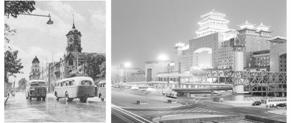 (用多媒体或图片展出旧北京城和现代北京城的照片并做比较,从而引出生词。)
T: Let’s look at the place which Kangkang’s granny lived in. It was old Beijing. What were Beijing’s roads like? Look at today’s Beijing. What are Beijing’s roads like now?
S1: In the past Beijing’s roads were narrow.
S2: But Beijing’s roads are wide now.
T: You’re right. Do you know how to keep in touch with our friends far away?
(板书narrow,要求理解。)
|
narrow |
(板书,讲解且要求掌握。)
|
far away, keep in
touch with |
S1: We can keep in touch with our friends on the Internet.
S3: We can also use fax machines.
S4: We can use cellphone to keep in touch with our friends.
T: Great. But do you know how people kept in touch with their friends in the past?
S1: They used to write letters.
T: Yes, good. At that time if we wanted to keep in touch with others, we could also send telegrams. OK, we know, in the past we could write letters, and send telegrams to keep in touch with our friends. But nowadays we can use many sorts of communications methods, such as telephones, cellphones, fax machines, the Internet and so on.
(板书telegram, fax,要求理解。板书sort和communication,要求掌握。)
|
fax, telegram, sort, communication |
T: In the past the communications were slow, but today’s communications are very quick. So we can say, China has made rapid progress.
(板书,掌握生词quick, rapid, progress)
|
quick,
rapid, progress |
2. (开展全班讨论活动,主题为“我和爷爷奶奶比童年”,复习新社会的幸福生活,感受社会进步。并逐一汇报。)
S1: We have a balanced diet.
S2: We can wear different kinds of clothes.
S3: We can also get a good education. For example, we have chances to draw pictures, play musical instruments and receive some other training.
…
Step 2 Presentation 第二步 呈现(时间:12分钟)
湖北省互联网违法和不良信息举报平台 | 网上有害信息举报专区 | 电信诈骗举报专区 | 涉历史虚无主义有害信息举报专区 | 涉企侵权举报专区
违法和不良信息举报电话:027-86699610 举报邮箱:58377363@163.com far away
 happen
to sb./sth.
happen
to sb./sth.