
4. listening
t: I have a good friend. His name is Rick. What does he usually do every morning, do you know? Let’s look at the pictures on page 65 and do 1b. Listen and match the times and actions. Draw lines from the clock to the pictures. Ready? Go
(students listen to the tape, then check the answer.)
T: Work in pairs, one student is Rick. The other is the interviewer. Ask and answer questions about Rich’s day.
( Students practice interviewing in pairs.)
------------------------------------------------ -------------------------
Step five: survey
T: Work in groups of four and fill in the chart using the drills “what time do you ..?”
What time do you …?
|
Name→ |
|
|
|
|
|
Get up |
|
|
|
|
|
run |
|
|
|
|
|
Take a shower |
|
|
|
|
|
Eat breakfast |
|
|
|
|
3. Talk about the pictures.
T: Who can ask and answer about the two pictures?
S: What time do you usually listen to music?
S: I usually listen to music at …
S: What time do you usually play basketball?
S: I usually play basketball at …
(at this time, teacher can prepare more pictures to practice.)
2. Practice the drill in pairs with the phrases “go to school, run, eat breakfast, take a shower.’
S: What time do you usually …?
S: I usually … at …
(the teacher asks more pairs to practice.)
1. Present the new drills
T: I usually get up at five o’ clock. What time do you usually get up?
S: I usually get up at …
T: What time do you usually get up?
S: I usually get up at …
(the teacher asks another students to practice.)
5. Talk about the picture.
T: Who can do it?
S: I can. I go to school at seven five. I go home at …
------------------------------------------------------- -----------------
Step 4: present the drill
4. Match the words and the pictures in 1a.
(s do 1a, then the teacher checks the answer.)
3. practice the new words and some phrases.
(show the time)
T: I usually get up at 5 o’clock. I run at 6 0’clock. I eat breakfast at 7 o’clock. What about you?
|
T: I swim at ten o’clock. What about you?
S: I … at … o’clock.
2. present the time
T: Look at the clock. Tell me the time like this.
|
S: Six o’clock
S: Seven o’clock
…
T: Look at the picture in 1a, say the time one by one.
S: One o’clock …
T: How to say “7:05,7:10 , 7:15…”in English? We can say
Seven five, seven ten, seven fifteen…practice the time.
6:10 6:25 6:30 6:45 6:55
﹡Step3 present the new words
|
S: Yes/no
T: Read after me, “get up”
S: Get up
T: I take a shower everyday. Do you take a shower everyday?
S: Yes/no
T: Read after me, “take a shower”.
S: “Take a shower”.
T: Do you run every day?
S:Yes/no
…
(then learn “go to school”, “go to bed” in the same way)
1. review the number
T: Look at the clock. Count the number on it.
S: one, two, three …
T: Who can count the number from 13 to 2o?
S: Thirteen.
T: Count the number from 13 to 20 together.
S: …
T: Then count the number from 21 to 30.
S: Twenty-one …
T: Count the number from 1 to 30 together.
S: …
10. A. think B. thinks C. thinks of D. think of
Key: 1.A 2.C 3.B 4.A 5.D 6.A 7.B 8.C 9.C 10.D
美国电视剧分类
I heard that a new sitcom is coming out next season.我听说下一季会推出一个新的情境喜剧。
讲到美国的电视文化,就不能不提一下美国电视剧的分类。其中比较常见的包括了像是 soap opera (肥皂剧),sitcom (情境喜剧),和 drama (电视剧)。其中 soap opera 有点像是连续剧 (serial),通常各集之间的故事都有关联,而且很会拖戏,有时候几个星期不看,剧情居然也还接得上!有的剧情演了 20 年,如The Young and the Restless 就是一例。但国内的连续剧的播放时段都是在晚上的黄金时段 (prime time),美国的 soap opera 却是在下午的时间播放的。主要的考虑是因为 soap opera的主要观众来源通常是无聊的家庭主妇,下午在家没事作的空档就是她们观赏 soap opera 的最好时段。至于为何叫 soap opera?则是因为当初赞助此节目的是家肥皂(soap) 公司,故名称一直延用至今。
Sitcom 则是所谓的情境喜剧 (situation comedy),顾名思义,每一集的情境喜剧通常会有一个独立的情境 (situation),而喜剧 (comedy),就是要搞笑,所以通常至少三分钟要一小笑,五分钟要一大笑,配音还会加上罐头笑声以帮助观众发笑。像Friends (六人行)、Will and Grace、Ally McBeal (艾莉的异想世界)、Growing Pains (成长的烦恼) 和 Sex and the City (欲望城市) 等都是 sitcom 个中翘楚。另外有一类和 sitcom 类似,也是每一集有独立的故事,但内容并非以搞笑为主,这类的节目叫 drama,其中最著名也最为国人所熟知的大概首推 ER (急诊室的春天),和 The X-Files (X档案) 了。但若是每集独立的剧集称为series (单元剧);若分数集的,称为 mini-series (迷你影集),例如∶Shogun, Roots, North and South 等等都是。
Tiger Woods will appear on "Larry King Live" on Friday.老虎伍兹将出现在星期五的赖瑞金脱口秀上。
美国电视节目中具影响力的节目除了戏剧之外,还有 talk show (脱口秀)、game show (益智问答) 和 cartoon (卡通) 等等。Talk show 的代表不外乎是 The Oprah Winfrey Show(奥普拉·温芙蕾脱口秀)和 Larry King Live (赖利金现场)。首先谈谈 Oprah Winfrey,她是一位黑人妇女,同时也是全球头号电视富婆,八届电视艾美奖得主。她的脱口秀是全美收视率最高的节目之一,能上她脱口秀的来宾个个都是来头不小的人物,而且据说上她的节目还没有钱拿,但大家还是趋之若鹜。Larry King则是 CNN 电视台的头号脱口秀主持人,他不但辩才无碍,再加上他时而咄咄逼人,时而幽默风趣的主持风格,使他所主持的 Larry King Live 成为美国最受欢迎的脱口秀之一。有些 talk show 也可以call in,所以也称为 talk & call-in shows。其他品味不高却广受欢迎的talk & call-in shows还有 Jerry Springer,Ricki Lake 等等。
Game show 类的代表性节目则是 Who Wants to Be a Millionaire (谁想当百万富翁) 这个由 ABC 原创的益智性节目曾经一度是该电视台黄金时段中收视率最高的,只要参加的来宾能回答出全部的问题,一百万美元的奖金就可以立刻落袋。但好景不常,随著收视率下滑,现在这个节目已经不在黄金时段中播出。其它著名的 game show还包括了 Jeopardy (老在 Friends 之前播出,所以我常看。)、Let's Make a Deal! 和 Wheel of Fortune 等等。
Cartoon 方面我想我不得不提 The Simpsons (辛普森家庭) 这个几乎已经成为美国象徵之一的卡通。这部卡通人物的构成线条十分简单而且色彩鲜明,主角 Simpson是一位在核电厂上班的员工,而他和他的家庭所住的村庄 Springfield唯一明显的地标则是一座终年在燃烧的垃圾山,但这村庄内什么都有,包括了酒吧、便利商店、山谷和河流。故事本身虽然看来平凡无奇,但它却受到广大成人观众的喜爱。原来 TheSimpsons的内容都别有深意,而且编剧们 (据说是一群从哈佛毕业的高材生) 都特别喜欢针砭时政嘲讽为政当局。例如有一次前副总统奎尔 Quayle 在小学看到小学生拼potato 这个字,他在电机机镜头下指正小学生说你拼错了,应该是 potatoe 才对,而事实上呢,是小学生的拼法没有那个 e 才对。结果当周的 The Simpsons 的一开头就是 Bart (Simpson 的儿子),在学校被老师在黑板上罚写,"Potato, not potatoe" 藉以嘲讽副总统大人连小学生都不如。这就是 The Simpsons 这部卡通的一贯风格。The Simpsons 中也常常请名人客串配音 (do the voice-over) 这一点也增加节目本身的可看性。
摘自:
表达喜欢与不喜欢
在英语中,表达喜欢或不喜欢有很多方法,不同的方法反映了不同的程度。
如果你爱某样东西,可以说“I love…”。如:
I love eating ice-cream. / I love travel.
如果你很喜欢某样东西,可以说:“be fond of…”,“I like…”。如:
She’s fond of Chinese food. / I’m fond of swimming very much.
如果你喜欢某样东西,可以说:“I like…”
He quite likes going to the cinema. /I like cooking.
如果你既不喜欢也不讨厌某样东西,可以说“I don’t mind…”
I don’t mind doing the housework. /I don’t mind walking to work.
如果你不喜欢某样东西,可以说“I don’t like…”,“I dislike…”
She doesn’t like cooking very much. /I dislike wasting time.
如果你很不喜欢某样东西,可以说“I can’t bear…”,“I can’t stand…”,“I hate…”
I don’t like sport at all. /He can’t stand his boss.
She can’t bear the noise from the street.
I hat being disturbed when I am working.
dislike这个词比较正规,fond of多用于和别人谈论食品。而一般用like的话,则要跟名词或动名词,如:I like something or like doing something。very much或a lot这类副词要跟在名词后面。如:I like reading very much,而不“I like very much reading”。
Hip-Hop Fashions
What kinds of clothing styles do you like to wear?
Do you like to “dress up” or “dress down”?
Teenagers who listen to the same music often have a common(共同的) “look”. One hot style(风格)in music and fashion is hip-hop. Hip-hop is a type of urban music with a heavy beat. The lyrics(抒情)are very important in this music. Hip-Hop fashions are large or loose-fitting street clothes. The style includes(包括)baggy jeans, sweatshirts, hiking boots, and baseball caps (usually worn backward). However, teens add other clothing items like flannel(法兰绒)shirts, jackets with sports logos, and athletic shoes. In the hip-hop style, boys and girls dress the same.
African American kids in Detroit and Chicago first made hip-hop fashions popular- they wore baggy street clothes to dance clubs. Then North American and European bands also began wearing this style. These bands influenced (影响)one another’s music and clothing. This mixture made hip-hop into an international fashion sensation.
Hip-hop is now a teen fashion from Britain to Japan. Melanie Borrow, 17, of Manchester, England, says, “My pride and joy in life are my Levi’s jeans.” In Japan, hip-hop is replacing(代替)the usual outfit for teenage girls: blouses and skirts with cartoon characters on them. And in the United States, teens spend a lot of money on hip-hop fashions. David Bowen, 17, of Evanston, Illinois, has five pairs of hiking boots at $100 each. Bowen says, “ They’re popular because a lot of hip-hop performers wear them. They even rap about them.”
According to the article, which of the clothing items are hip-hop fashions? Check (√)the correct items.
(根据文章挑出属于 hip-hop的服饰)
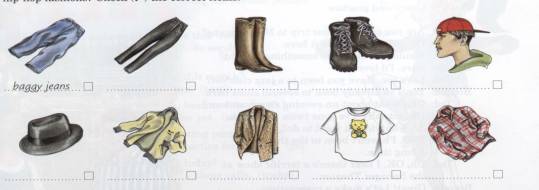
Answer the questions. (请回答下列问题)
Do you ever listen to urban or hip-hop music?
________________________________________________________
Do you ever wear hip-hop fashions? Describe what you wear.
________________________________________________________
What do you wear when you dress up or dress down?
________________________________________________________
(baggy jeans, hiking boots, baseball cap, jacket, T-shirt, shirt)
为何电视连续剧被称为“肥皂剧”?
“电视连续剧”英文为TV play series,然而很多国家称之为“肥皂剧”(soap opera)。这还得从广告(advertisement)说起。
当电视问世不久,一些肥皂厂商发现利用电视宣传、推销其产品比其他广告更有效。但是时间一长,干巴巴的广告不仅不能吸引观众,甚至使观点感到厌烦。而这些肥皂厂商又不愿放弃电视广告,于是想出个新招,给电视台一笔重金,让其出高价聘请剧作家编写故事情很强、情节动人的剧本,然后构成多集电视剧,逐日在电视节目中播放。播放过程中,把肥皂广告再巧妙地加进去。这样,观众在欣赏电视连续剧的同时也看到了广告。由于这种电视剧中间有肥皂广告,于是人们就叫它“肥皂剧”。
湖北省互联网违法和不良信息举报平台 | 网上有害信息举报专区 | 电信诈骗举报专区 | 涉历史虚无主义有害信息举报专区 | 涉企侵权举报专区
违法和不良信息举报电话:027-86699610 举报邮箱:58377363@163.com