
2. Pair work or group work to have a discussion.
Teaching aids教具准备
A computer and a projector.
Teaching procedures & ways教学过程与方式
Step I Revision
T: Good morning/afternoon, boys and girls!
Ss: Good morning/afternoon, Sir/ Madam!
T: Do you like reading?
Ss: Yes. We all like reading!
T: I don’t think so. Whenever I see you, you are talking about sports, music, food, clothes, pictures, stars and so on, but seldom are you talking about reading.
Sa: You are partly right, Sir/Madam. We seldom talk about reading just because we have different interests in different kinds of literature works and different themes.
Sb: Also because we have to read so much for school everyday and have so little time to read what we like for pleasure.
T: Oh, I’m sorry for what I said just mow. That is to say, you did your homework very well yesterday?
Ss: Certainly!
T: And you have got as much knowledge about American literature as you can?
Ss: Yes!
T: Great! Let’s have a competition between boys and girls. Those who like to join in the competition stand in lines, boys stand on the left, girls right. Our competition will go on like this: Each of the group numbers will write out one work with its writer’s name on the blackboard, do that in turn in each of your groups as quickly as you can. You can write different works by the same writer, but can’t write the same work. OK? Another thing: If you both get the same number of the works, the group with more different writers will be the winner. We’ll finish it within three minutes. Are you ready? One, two, three, go!
A few minutes later, check the work together and congratulate on the winning group. Then hand out the prizes prepared for the winners to encourage them.
Possible result (B): black writer
|
Boy
Group The Adventure of Tom Sawyer ——Mark Twain The Beast in the Jungle ——Henry James Main Street ——Sinclair Lewis Native Son ——Richard Wright (B) The Scarlet Letter ——Nathaniel Hawthorne The Old Man and the Sea ——Ernest Hemingway The Call of the Wild ——Jack London Martin Eden ——Jack London |
Girl
Group Adventures of Huckleberry Finn ——Mark Twain The Cantos ——Ezra Pound The Grape of Wrath ——John Steinbeck Invisible Man ——Ralph Ellison (B) A Farewell to Arms ——Ernest Hemingway The Gift of the Magi ——O. Henry The Last Leaf ——O. Henry ... |
The boy group wins the competition with seven different works and writers.
Step II Warming up
Talk about some famous American writers and their famous works appearing on the screen.
T: You did a great and exciting job just now. Well, let’s look at some pictures. Do you know something about them? If you know, please tell us as much as you can.
Show some pictures about some famous American writers such as Mark Twain, Ernest Hemingway, O. Henry, Nathaniel Hawthorne, and so on. At the same time, ask the Ss to try to talk about the pictures in order that the Ss can draw as much information about American literature as possible.
Show the picture of Nathaniel Hawthorne and his famous work The Scarlet Letter on the screen.
T: Who’s he? And have you read the novel?
Sa: He is Nathaniel Hawthorne. I know a little about him. Hawthorne is a novelist and short story writer and The Scarlet Letter is one of his most successful works. But I haven’t read the novel.
T: Good. Do you know some other best-known works written by Hawthorne?
Sb: Let me try. The House of the Seven Gables, Twice Told Tales and The Artist of the Beautiful.
T: Very good! Let’s see something about him.
Show the brief introduction on the screen and ask someone to read it aloud.
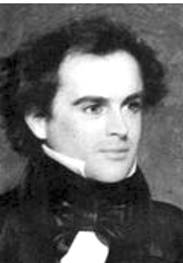
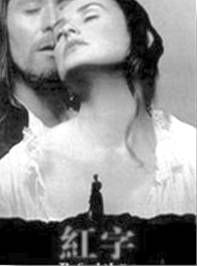
|
Nathaniel
Hawthorne Born in Salem, Massachusetts. Novelist and short story writer, a central figure in the American Renaissance. Nathaniel Hawthorne’s best-known works include The Scarlet Letter (1850) and The House of the Seven Gables (1851). |
T: We have learned something about Nathaniel Hawthorne. Now look at this! Have you read the story? And do you know something about its writer?
Show the pictures of Harriet Beecher Stowe and her famous work Uncle Tom’s cabin on the screen.
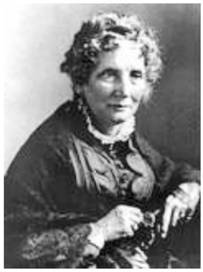
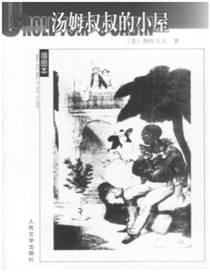
Sc: Yes! Many of us have read the story. It is an antislavery novel written in 1852 by Harriet Beecher Stowe. The story was about a faithful black slave was killed by a cruel white enslaver and made people know how cruel the slavery was. It aroused the people’s sympathies.
T: Great! Now, let’s learn something more about Harriet Beecher Stowe.
Show the brief introduction on the screen and ask someone to read it aloud.
|
Harriet
Beecher Stowe Born in the USA. in 1811. Her book Uncle Tom’s cabin not only made her famous but also shook the world and was helpful in causing the American Civil War. There was time when every English-speaking person had read the novel that did so much to stop slavery. President Lincoln greeted her as the “little woman who wrote the book that made this Great War.” |
T: Have you read these poems?
Show the poetry anthology on the screen.
Ss: No. Heard about it but haven’t read it. / Yes. The poems in the anthology are wonderful...
T: Yes. That is a wonderful poetry anthology written by a great poet Walt Whitman. In 1855 Whitman published a volume of 12 poems at his own expense, Leaves of Grass, which he had begun working on probably as early as 1847. It was criticized because of its innovation in verse form, that is, the use of free verse in long rhythmical lines with a natural, “organic” structure.
While introducing the writer and his poems, show the portrait of Walt Whitman and the book and the log cabin where the work was born on the screen.
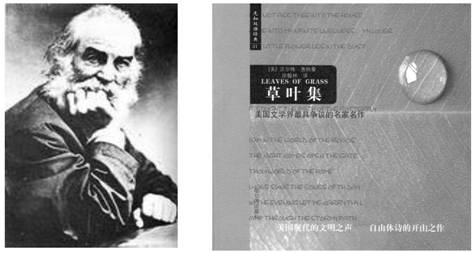
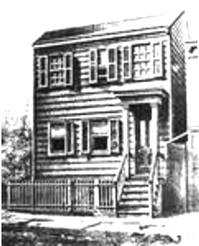
T: Now let’s appreciate the verses from one of his poems.
Show the verses on the screen.
|
O
Captain! my Captain! our fearful trip is done; The ship has weather’d every
rack, the prize we sought is won. ——O Captain! My Captain! Walt Whitman |
T: Can you taste the deep meaning?
Ss: Sorry ...
T: Here Walt Whitman compares America to the ship, Lincoln to the captain. The ship “has weather’d every rack”, while their great captain lay down forever.
Ss: ... (The Ss will feel very sorry when hearing this.)
T: Yes. That is what good literature works bring us. Look, You must have read this book.
Show the book The Adventure of Tom Sawyer on the screen.
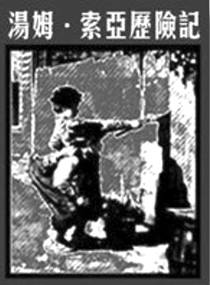
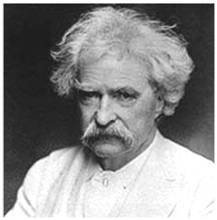
Ss: Yes! Almost everyone has read the book. That’s very interesting and exciting and meaningful!
T: Who wrote it?
Ss: Mark Twain!!
Show the picture of Mark Twain.
T: Mark Twain is his pen name. Do you know his real name?
Ss: Samuel Langhorne Clemens.
T: That’s right. Can you count more of his works?
Sd: Certainly! Besides The Adventure of Tom Sawyer, he wrote many interesting and humorous stories such as Adventures of Huckleberry Finn, The Mysterious Stranger, Life on the Mississippi, The Gilded Age and son on.
Se: Along with essays, critical works, and more.
T: Very good! Here on the screen are some more information about Mark Twain. Please go through it by yourselves.
|
About
Mark Twain: Mark Twain, pen name of Samuel Langhorne Clemens, was a great literary giant of America, who was considered “the true father of our national literature”. The typical theme in Clemens’ writing was the narration of a story by a young or native person. When he wrote about youth, the youth was usually wise beyond his years but remained an idealism which Clements compared with the insincerity and cruelty of the adult world. |
T: Till now, we’ve learned about many famous writers of America and their works, but have you read this work? Pointing to the poem on Page 82.
Ss: No, we haven’t.
T: Now please read it carefully twice or three times, then go though the questions given below and have a discussion in groups of four. A few minutes later, I’ll check your jobs.
If there is enough time or the students have enough knowledge about the American literature and writers, the teacher can have the Ss talk more about them.
A few minutes later.
T: Are you ready?
Ss: Yes!
T: Everyone knows that the text you’ve just read is a poem, yes?
Ss: Yes! That’s very clear.
T: Can you guess who wrote the poem? I mean, was it written by a white poet or a black one?
Sf: I think it was written by a black poet.
T: But why do you think so?
Sg: Because it’s talking about lowest working people all the way and gives them and their work high glory and shows the respect to their ancestors.
Sh: I think so. Although “the black” isn’t mentioned a single time in the poem, still I can feel it was written by a black poet through the sensibilities and the languages. It describes the hard work of their ancestors as well as their poor living conditions. Who once lived a miserable life like pigs? Slaves! Who once were forced to be slaves? Black people!
Si: Yes. And who made the black people, born free ones, slaves? The early white settlers in America! So I can judge it must be American literature, and couldn’t be written by any poet from another country. Also I can read out the black people’s aspiration for freedom and equality.
T: Good! Wonderful deducing! And what deep thought can we get from the poem?
Sj: I think the poem is about accusing of slavery and the unfairness of the society. It shows us a spirit of freedom and tells us that people are born to be equal and nobody is nobler or lower.
T: Very good answers, and you all have deep thinking about the purpose of the writer.
Sk: Just now Si said it must be American literature, I agree with it. From the history and the substance of the poem we can know this. America used to be a colony of England. Slavery existed in America for a long time. Slaves were treated cruelly as draught animals. As America had not a period of feudal, Americans didn’t believe in Kings and Queens. After the Independent War and the Civil War, America marched on to freedom. At that time, slavery had been abolished but the thinking of slavery and racial discrimination still rooted in the minds of Americans. The writer wanted to break the wall between people, call for equality and black people’s self-respect and confidence. So he wrote this poem.
T: Great! You’ve analyzed the history origin and made the answer reasonable. And then, who can tell us something about the writer, whose name was marked below the poem?
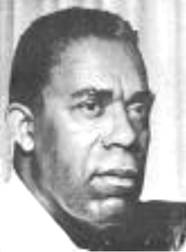
Sl: I know something about him. Dudley Randall was born in Washington, D.C. in 1914. He worked during the Depression in the foundry of the Ford Motor Company in Dearborn, Michigan, and then as a carrier and clerk for the U.S. Post Office in Detroit. He served in the U.S. Army Signal Corps, and graduated from Wayne State University and the University of Michigan.
Sm: He was a librarian at several universities, and founded the Broadside Press in 1965 “so black people could speak to and for their people”.
T: Very good. And what about his idea to the black poets?
Sn: Randall told Negro Digest, “Precision and accuracy are necessary for both white and black writers ...‘A black aesthetic’ should not be an excuse for sloppy writing.” He urged African American writers to reject what was false in “white” poetry, but not to forsake universal concerns in favor of a racial agenda.
T: Wonderful and clear! Who can tell something about his achievements?
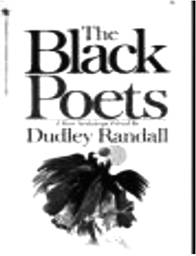
So: Let me try. His works include On Getting a Natural and A Litany of Friends; New and Selected Poems. He edited The Black Poets, an extensive anthology of poetry, from slave songs to the present.
T: Excellent jobs you’ve done!
Show the pictures of Dudley Randall and one of his works.
T: When looking back the history and life in the United States, what special themes and what sort of stories would you expect for American literature? I want to know your ideas.
Sp: I want to report my idea. America used to be a colony of England and slavery existed for a long time. Freedom came true after the Independent War and the Civil War. There were a lot of stories about love and courage in wars. So the fights about American especially black people who fought for freedom and equal rights must be very exciting.
Sq: I’ve read the story Adventures of Huckleberry Finn written by Mark Twain, which is about a white boy and a black slave running away from their terrible places together to have their adventure travel. The story is very interesting and exciting.
Sr: I expect for themes about wars. The furious war can show us the strong force to the slavery and bring us courage and power. Certainly, this theme can make us feel excited and thrilling.
St: The themes about the common people’s life of America will be attractions, from which we can know more about the real life of people in lower class. This kind of themes is often realistic and moving with kind and hard-working characters in them. We can learn more from them and get edification in heart.
T: Good! And you have so much wonderful thought that I almost want to read all of the themes of the American literature works. How could I do and which one should I choose?
The Ss will have a variety of ideas about the themes of American literature. Deal with the situation about their discussion and let them report freely depending on time and the case. Collect the ideas about their interesting themes by making a form for the students to fill in.
Possible list
|
Themes |
Works |
Writer |
|
Antislavery
and Civil War |
Uncle
Tom’s cabin The Slave |
Harriet
Beecher Stowe Richard Hildreth |
|
Native
American |
The
Adventure of Tom Sawyer Life on the Mississippi |
Mark
Twain |
|
Western
Pioneers |
Shane |
Jack
Schaefer |
|
Neuter |
Leaves
of Grass |
Walt
Whitman |
|
Common
life |
The
Gift of the Magi |
O.
Henry |
|
… |
… |
… |
Step III Speaking
T: From what you did just now, I believe you’ve known much about the American literature. You know the major themes in the literature of a country reflect important events or periods in the history of the country. There are four pictures here about American literature. Look at them and use your history knowledge about the USA. Work in pairs and discuss what kind of stories you’d like to read, using the useful expressions on Page 84. A few minutes 1ater, I’ll ask some of you to present your ideas in the form of dialogues to the class. OK?
Ss: Yes!
The students start to have a discussion in pairs, while the teacher goes among them to see if they have any questions and directs the students’ activities.
A few minutes later.
T: Are you ready?
Ss: Yes.
T: Who wants to be volunteer?
Ss: (The first pair) Let us have a try.
Possible Dialogues
Picture 1
A: Do you know who was the native of America before European came?
B: I think, it’s Indian, American Indian. There are a lot of stories about them, and some are very interesting, especially some about the relationship between Indians and white persons.
A: Really? I feel the urge in my heart to know something about them. Do you know any famous novels about them?
B: Sorry, but I have seen a film named “Dancing with the wolves”, it’s a story about a captain, an English white man, who went to the west part of America, when a lot of people had gone there and Indians were discriminated and killed by white persons. He made friends with a group of Indians and helped them not be hurt by white people. It’s a very sad story.
A: There must be an exciting plot! I won’t miss it.
B: I hope you can enjoy it.
Picture 2
A: I like cowboy very much and I even dream that I can go to America and be a cowboy one day.
B: Well, it is really a wonderful dream. But how much do you learn about the life of cowboy in America?
A: Very little, that is what I want to know.
B: I think I can tell you something about it. When the population of settlers became larger and lager in the 1800s, many people went to the west land. They were attracted by the low price of the land and the chance to earn money. At that time, cows were more than people, so cowboys were needed. To run after the cows, cowboys rode horses and wore leather boots. They created their special songs, stories, lifestyles and special characters. If you want to know more about them, you can read some books, for example, Life on the Back of Horse and The Notorious Jumping Frog of Calaveras County.
A: Thank you very much. I will go to the library.
Picture 3
A: You have been to the library, haven’t you?
B: Yes, I’ve just borrowed some interesting books.
A: Well, let me see. Er… You seem to like Mark Twain.
B: Not very much, but I really like his novel Adventures of Huckleberry Finn, his well-known book.
A: It sounds interesting. What is it about?
B: The story happened during American Civil War. A clever and kind-hearted boy named Huckleberry Finn helped his friend, a slave, escape from his owner’s garden. They traveled along the Mississippi, and finally they got to the north part of America. During their incredible trip, they built a friendship. As the slave got freedom, the story got a happy ending. The story shows us some facts of the war and tells us that the slaves should be treated fair.
A: It is really interesting. I hope I can read this book when you finish reading it.
B: No problem!
Picture 4
A: Do you know something about the Great Depression at 1933-1937?
B: It’s a terrible event for the whole world. No one can forget it. Millions of businesses went bankrupt, millions of people lost their jobs, and millions of people could not support their children’s food. It was also one reason of the World War II. If you want to know it, you can read the book “Live of Roosevelt”. It describes this event.
A: No, I don’t want to read this kind of books. I want some stories at that time, just for pleasure. It needs interesting characters, exciting plots and so on, you know?
B: Oh, would you like to read novels? You’ve found the right person! You can read some stories written by Francis Scott Fitzgerald such as The Great Gatsby, Tender Is The Night and The Last Tycoon. His works lay out the bleak visage in spirit in American upper class during the Great Depression. I also advise you to see some films of Chaplin, his films reflect the lowest-class life at that time and they are very interesting and can give you a lot of advice to fight with terror.
T: Very good and wonderful job! Thank you and sit down, please!
Step IV Talking (Workbook on Page 218)
Let the students work in groups of four. Choose one of the groups of the authors and have the discussion about why such books are popular or not popular in China. While the Ss do their group work, go among them to see if they have any questions and direct them. A few minutes later.
T: Would you like to make the class know the outcome of your discussion?
Ss: Yes!
T: Who’d like to be the first?
Ss: (The first group) We’ll try first. We’d like to talk about Edgar Snow.
A: Edgar Snow was an American journalist reporting on China, and was famous for his book Red Star Over China. I’ve read it. It’s very authentic and moving.
B: What is the book about? I heard about it but haven’t read it. Is it popular in China?
C: Yes it’s very popular. In 1936, he started his travel from Beijing and at last he got to the Red Areas of China. There he interviewed Mao Zedong and recorded factually everyday life of the revolutionists of China.
D: In November of 1936, he went back to Beijing and wrote down what he saw and heard. At last, he collected all his reports in the book Red Star Over China.
A: There is another reason why it is popular in China. It is the first book written by a westerner, in which the Red Areas and the people there are reported factually.
C: Edgar Snow was an honest person. He always sought true facts in both his books and life. And he is a good friend of Chinese people.
B: I see! The popularity of his book is based on his noble character. I must read his book carefully.
T: Very good! It seems that most of you have read the book. It’s really popular in our country.
Ss:(The second group) We’ll talk about Israel Epstein.
A: I’m reading the book Woman in World History: Life and Times of Soong Ching Ling written by Israel Epstein.
B: Oh, I have heard of him. He was born in Poland and became a Chinese citizen in 1957.
C: But I heard he died 4 days ago!
D: Yes. He had been living and working in China for more than 70 years. He wrote books about Chinese history, China’s revolution and construction.
C: I heard that he was a personal friend of Soong Ching Ling and the book you are reading is a biography he wrote for her.
D: He loved China and Chinese people very much, so the books he wrote are very popular in China
T: Wonderful job! Do you have any different ideas?
Ss: (The third group) We have some views about Pearl S Buck.
A: The Good Earth is about Chinese peasants’ life in the 1930s written by Pearl S Buck, who gained Nobel Prize of literature for this book.
B: I have read this book, it describes Chinese peasants’ life factually and deeply. When it was published in 1931, it soon became best seller in America and was translated into many languages.
C: She’s a western woman writer with disputation. In China, someone likes her work while someone not because the description about Chinese peasants’ life is the thought to have suspicion of smear.
D: Yes. In 1935, when the book was published, it caused a great uproar in the world. Whether or not, it has been translated into many languages and is widespread in western countries. It contributed a lot to the positive image that Westerners have about Chinese people.
T: You really have deep thought about the author. That’s valuable. Anyone else?
Ss: (The group four) We want to say something about Lin Yutang, who’s the only Chinese among the authors given.
A: Do you know about Lin Yutang?
B: Certainly! He was a famous writer and learner in the early twentieth century in China. He once taught in Qinghua University and then went to study in America and Germany. In the 1920s he came back to teach in Beijing University and he was a supporter of the patriotic student movement.
C: Lin Yutang wrote a lot of articles and books and created many kinds of magazines. He wrote more than 30 books in English, of which My Country and My People was the most popular.
A: What is it about?
D: It describes temperament, heart, dream, life, honesty, society and culture of Chinese and contrasts them with those of westerners. He was a Chinese writer with a great influence on western understanding of the Chinese.
A: But why don’t I know these? Perhaps I read less than you did? Or he seems not to be so popular?
T: That’s very good!
Ask some more groups of the students to act out their dialogues. There may be a variety of possible ideas to come up with.
Step V Homework
T: You have done very well in the class. That’s all for this period. Homework for today:
Find out some good English little poems to read aloud, you can do that with music. And if possible, you can make some slides on PowerPoint to show your poems to the class while you are reading aloud. Prepare for the work carefully and you’ll get a lot of fun with it. Goodbye, everyone!
Ss: Goodbye, sir/madam.
1. Talking method;
3. Learning ability goals 学能目标
Help the students learn how to predict the themes of novels according to given information.
Teaching important points教学重点
Let the Ss learn to describe and predict different themes of American literature and what type of stories they would like to read.
Teaching difficult points 教学难点
How to express their ideas about different themes of American literature in the proper way such as an exciting plot, characters, when and where the story taking place and so on.
Teaching methods教学方法
2. Ability goals能力目标
Enable the students to talk about the themes of American literature, tell what type of stories they like to read and discuss why some books written by American writers are popular but some are not so popular.
The First Period Speaking
Teaching goals 教学目标
1. Target language目标语言
a. 重点词汇和短语
theme, American literature, native Americans, slavery, the Civil War, as a guide for, outcome
b. 交际用语
What would be an interesting story?
What would be an exciting plot?
What characters would appear in it?
What would the characters be like?
Where would the story take place?
When would the story take place?
Would you like to read a short story or a novel?
Do you want to read for pleasure or for school?
3. 课型设计与课时分配(经教材分析,根据学情,本单元可以用6课时教完。)
1st Period Speaking
2nd Period Listening
3rd Period Reading
4th Period Extensive reading
5th Period Language study
6th Period Extensive Reading && Writing
2.6 将 Workbook 中INTEGRATING SKILLS 的READING(泛读)“以及WRITING整合成一节“泛读与写作课”。
2.5 将 LANGUAGE STUDY 与Workbook中的PRACTISING部分整合在一起,组成一节“语法课”。
湖北省互联网违法和不良信息举报平台 | 网上有害信息举报专区 | 电信诈骗举报专区 | 涉历史虚无主义有害信息举报专区 | 涉企侵权举报专区
违法和不良信息举报电话:027-86699610 举报邮箱:58377363@163.com