
3. (自主学习,把3中的道歉语与应答语连线,使内容匹配。)
T: If we do something wrong, what should we say? How to express our apologies?
Ss: We can say (I’m sorry).
T: Right. And their responses?
S: …
(可以让学生自由说他们认为可以回答Sorry的话,然后老师给予总结,补充。)
T: OK. Now look at 3 Work alone. Please match each apology with the best response.
(核对答案。)
Step 5 Project 第五步 综合探究活动(时间:7分钟)
2. (打开第12页的2完成2。)
T: Open your books, turn to page 12. Complete the short conversations with the phrases in the box, then practice in pairs.
For example:
S1: You kept me waiting so long. Would you mind serving the food quickly?
S2: Sorry. It’ll be ready soon.
(请4组同学到台前表演。)
1. (通过复习Would you mind doing sth.?学习生词。)
(教师把录音机调到最大音量,指着录音机问。)
T: Boys and girls. Do you think the recorder speaks too loudly?
Ss: Yes, it’s so loud.
T: S1, would you mind turning it down?(老师边说边演示,并让S1把录音机音量调小。)
S1: OK.(去调音量。)
T: Well done! It’s quiet now. But can you hear clearly?(老师做动作表示没有听清楚。)
Ss: No, we can’t.
T: (教师把录音机声音调适中。)Can you hear clearly now?
Ss: Yes, we can hear clearly.
(板书)
|
turn down clearly |
T: (老师指着教室内地板上脏的地方问) Is it clean here?
Ss: No, it isn’t.
T: Yes, it’s too dirty. S2, would you mind cleaning it right away? (让学生立即扫干净,同时解释。) “right away” means “at once”.
(板书并解释)
|
dirty right away=at once |
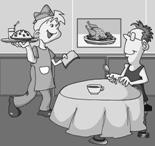 (展示一幅在饭店里,一名服务员正在上菜的图片。)
T: What’s the boy doing? He is serving the food.
(板书并解释)
|
serve |
(教师可用书本当盘子演示上菜的动作。)
T: Would you mind severing the food quickly?
Ss: It will be ready soon.(引导学生回答。)
(板书并解释)
|
ready |
(给学生1-2分钟熟读生词和短语。)
2. (师生一起列出1a中的关键信息、词语,找学生讲述1a的故事。完成1b。)
|
Kangkang, Michael, careless, miss, shame, Maria, Jane,
fight, say sorry to, win, be sure that, do better |
T: According to these key words, retell the story.
S3: …
(如果学生能力较强,也可以让他们以Kangkang或者Michael的角度来讲故事。)
Step 4 Practice 第四步 练习(时间:10分钟)
1. (让学生根据1a,完成1b。)
T: OK. Please read 1a again and fill in the blanks with the words in the box in 1b.
(在学生独立完成1b的过程中,板书。)
|
be angry
with sb. |
3. T: Listen to 1a again and repeat, pay attention to the intonation, stress and pronunciation.
(可让学生与录音机齐读或人机对话。)
Step 3 Consolidation 第三步 巩固(时间:8分钟)
2. (听1a录音,回答问题。)
T: Listen to 1a. Answer the following questions:
(1) Did Michael miss a good chance?
(2) Did Kangkang say sorry to Michael?
(板书)
|
Shame on you! do one’s best keep trying |
1.
 (利用图片导入新单词)

T: Look at Picture 1. What happened?
Ss: He broke his bottle.
T: Yes. He isn’t careful. He is so careless.
(板书并解释)
|
not
careful=careless |
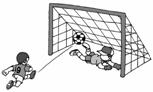
T: Look at Picture 2. What are they doing?
Ss: They are playing soccer.
T: Yes. Did the boy kick the ball in?
Ss: Yes, he did.
T: Well done! We can also say he got a goal.
(板书并解释)
|
got a goal |
T: If he didn’t get the goal, he would miss a good chance.
(板书并解释、领读。)
|
chance |
T: We have a lot of chances in our life. We should seize them. Do you understand?
Ss: Yes, we think so.
T: Look at Picture 3. What are they doing?
Ss: They are fighting. (引导学生给出答案。)
T: Yes, they are fighting.
(板书并解释)
|
fight |
T: Do you think it’s good or bad to fight with others?
Ss: It’s bad.
T: Right. Don’t fight with others. If you do that, please say sorry to him / her.
(板书解释)
|
fight with sb. say sorry to sb. |
T: S1, did you fight with your friends?
S1: No. / Yes.
(若回答Yes)
T: Who did you fight with? Would you mind saying sorry to him?(假设把与之闹矛盾的同学叫过来,用此机会让其和解。)
S1: I’m sorry.
S2: It’s nothing.(老师帮其回答。)
(板书)
|
It’s nothing.
|
T: Good, please shake hands.(让其握手。)
T: OK, look at Picture 4. What’s wrong with the boy?
Ss: He is angry. (帮助学生回答。同时做发怒、生气的表情。)
(板书)
|
angry |
2. 方案二
(做一个游戏,练习Would you mind not doing…?的表达。)
T: Boys and girls. Let’s play a game to practice how to make requests. First, let’s divide our class into two teams. Then team 1 makes statements with target language, team 2 expresses the same meaning with opposite language. For example, team 1: “Would you mind coming to class early?” team 2: “Would you mind not coming to class late?” then team 2: “Would you mind not talking loudly?” team 1: “Would you mind talking softly?” Clear?
(如果学生在接受教师指令时有困难,教师可在恰当的时候使用汉语进行表述。)
For example:
S6: Would you mind moving your bike?
S7: Would you mind not putting your bike here?
S8:Would you mind cleaning your room?
S9:Would you mind not making your room so dirty?
S10:…
(可以让学生在练习时,适当地加入回答。)
Step 2 Presentation 第二步 呈现(时间:15分钟)
Step 1 Review 第一步 复习(时间:5分钟)
1. 方案一
(让学生编对话请求别人做某事,复习Would you mind (not) doing sth?)
T: Practice and act out the conversations about asking others to do sth. in pairs. You should use the sentence patterns like “Would you mind (not) doing sth.?”, “Could / Would you please do sth.?” etc. Pay attention to how to answer these questions.
S1: Would you mind not making so much noise?
S2: I’m sorry about that. I won’t do it again.
S3: Would you please move your bike?
S4: OK.
S5: …
湖北省互联网违法和不良信息举报平台 | 网上有害信息举报专区 | 电信诈骗举报专区 | 涉历史虚无主义有害信息举报专区 | 涉企侵权举报专区
违法和不良信息举报电话:027-86699610 举报邮箱:58377363@163.com