
1.A.You’re welcome. B.I’m sorry to herar that.
C.The same to you. D.You must look after yourself.
2.A.Yes,there are. B.Yes,there is.
C.Yes,it is. D.It’s mine
3.A.He’s over there B.It’s over there
C.It’s far away. D.It’s at school.
4.A.Yes,they are. B.No,it isn’t.
C.Yes,there is. D.Why not watch TV?
5.A.Thanks a lot. B.All right.
C.That’s all right. D.Thank you all the same.
答案:1.I hurt my leg.
2.Is this bedroom mine?
3.Where’s your son?
4.Are they going upstairs to watch TV?
5.Thanks for telling me the way to the post office.
B C A A C
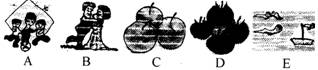
1. ________ 2. ________ 3. ________ 4. ________ 5. ________
答案:1.A:what’re the children doing?
B:They’re swimming.
2.A:What’re the man and WO~IaFt doing?
B:They’re dancing.
3.A:What’re the boys doing?
B:They’re playing football.
4.A:What can you see in the picture?
B:I can see three apples.
5.A:How many tomatoes can you see in the picture?
B:I can see four.
E B AC D
4. Danny says, "I'm looking for Brian. I can't find him. Have you seen him?"
Jenny says, "Yes. I saw him in the library.
He was looking up some words in the dictionary."
CLASS CLOSING (5 MINUTES
There is no specific reading from the reader to assign as homework for this lesson. This is a chance for students to catch up if they are behind.
Suggested homework for this lesson includes:
the remaining exercises in the activity book
3. Brian says, "I saw Tim today. He is my good friend. I haven't seen him for many weeks. He looks great. I saw him at a restaurant."
2. Mrs. Brown says, "There will be a good program on TV. It is about making movies. Don't forget to watch it. ?'
1. Li Ming says, "It is cold, isn't it?"
Wang Mei says, "Yes it is. It might get colder. It might snow."
1. Listen to the audiotape. Look at these questions. Can you choose the correct answers? Please try.
2. look, watch and see
DIFFICULT POINTS: the Present Continuous Tense
TYPE: a dialogue and a short text
TEACHING AIDS: some food, some pictures of furniture, audiotape, recordeer
CLASS OPENING (5 MINUTES)
For ideas and tips on beginning a class, see "Teaching Techniques" at the back of this teacher's guide. You may wish to have the class sing "Let's Take a Drive."
STUDENT BOOK (10 MINUTES)
There is one reading for this lesson. It reviews the vocabulary for this unit. There is no new vocabulary in this lesson.
There are many ways to teach immersion reading. Here are some step-by-step instructions for one way to teach the reading in this lesson. Also see "Teaching Techniques" at the back of this teacher's guide for more general information about teaching readings.
Step 1: Check to see if the students have previewed the text as required. Ask if they have any questions. Encourage other students to try to answer the questions. As a quick review, ask students to name the words they know for different kinds of vehicles.
Step 2: Play the audiotape.
Step 3: Depending upon how much time you have you may divide the class into small groups. Ask each group to think about, discuss and then write an e-mail in response to Jenny's e-mail to Li Ming. if there is time, ask some groups to share their writings with the rest of the class.
VERBS (20 MINUTES)
Review the irregular verbs in this unit: drive, ride and sly. See "Teaching Techniques" at the back of this teacher's guide for recommended methods of teaching verbs.
Review the verb can, which is also in this unit.
This is a special verb, like might. The students learned the verb "might' in Level 1 of junior school.
Do they remember what might means? Write this list on the blackboard:
I go. I might go.
He goes. He might go.
We go. We might go.
I run. I might run.
He runs. He might run.
We run. We might run.
Now ask for volunteers to write the same phrases with the word "can."
I can go.
He can go.
We can go.
I can run.
He can run.
We can run.
What do the phrases mean? "I (verb)" describes what you are doing now. "I might " expresses uncertainty. You might do something, but you might not. "1 can" expresses an ability. If you can do something, you are able to do it.
Sometimes "can" expresses permission. For example, you might ask your parents: "Can I go to the cinema?" If they permit you to go, they might say: "Yes, you can."
ACTIVITY BOOK (5 MINUTES)
Play the audiotape. The aural exercises for this lesson are:
1. the Present Continuous Tense
3. understand and write down some missing words as heard in sentences or passages in different contexts
KEY POINTS
湖北省互联网违法和不良信息举报平台 | 网上有害信息举报专区 | 电信诈骗举报专区 | 涉历史虚无主义有害信息举报专区 | 涉企侵权举报专区
违法和不良信息举报电话:027-86699610 举报邮箱:58377363@163.com