
2. (学生三人一组分角色朗读对话,教师板书对话中的关键词。给学生四分钟时间,让他们看着关键词表演。)
T: Now, work in groups of three. I will give you four minutes, and you should act out the dialog without your books. The key words on the blackboard may be useful. Now, let’s begin.
(学生可用自己的语言来表达,不要照搬课文原句。)
(板书)
|
see a traffic accident-hurt-crazy-get used to-first-be afraid of-obey the traffic rules-like riding-save-cause-easy |
T: Time is up. Who can act out the dialog?
(对于表达流利的学生,要给予充分的肯定和鼓励。)
T: S1 reads well. S2 reads better ...
Step 4 Practice 第四步 练习(时间: 12分钟)
学习2a,完成2b。
1. (放1a的录音,学生跟读,注意语音和语调。)
T: Please listen to 1a and follow the tape, and pay attention to your pronunciation and
intonation.
5. (教师简单复习不定式的用法后,紧接着让学生做1c。)
T: Next, please do 1c by yourselves. Hurry up!
(核对答案。)
T: OK, stop! Let’s check the answers. Who knows the answers? Hands up, please!
Step 3 Consolidation 第三步 巩固(时间: 8分钟)
巩固1a。
3. (教师向学生呈现对话中陈述的骑自行车的好处。)
T: Can you ride a bike?
Ss: Yes, I can. / No, I can’t.
T: Riding a bike can help ladies keep fit. Do you think so?
Ss: …
(让学生分组讨论骑自行车的好处和不利因素,使学生充分发挥自己的发散性思维,然后完成1b。派小组报告员发言,并给予记分。)
T: Riding a bicycle also can help us save energy and reduce air pollution. There are many advantages in riding a bicycle, aren’t there? Now, please discuss with your partner and finish 1b. Then I’ll ask one student from each group to give a report.
T: Stop! Please give your opinions to us.
S2: …
S3: …
…
(教师给每组记分,说得越多越完整,得分越高。)
T: Which group can get the best result?
(学生边说教师边板书。)
|
Advantages |
Disadvantages |
|
1. It’s faster
than walking. 2. It can keep us healthy. … |
1. It may make
you tired. 2. It is slow. … |
2. (教师布置学生自己默读,并判断正误。)
T: Please read the dialog silently by yourselves, and then mark the sentences on the blackboard true or false.
(板书)
|
There is only
one passenger hurt in this accident.(
) There is no accident in Beijing. ( ) When Michael first arrived, he was afraid of riding his bike anywhere. ( ) Riding bikes can help us save energy. ( ) |
T: Stop! Let’s check the answers. Who can tell me? Volunteers?
1. (教师设置并板书听力任务,让学生带着问题去听,并获取有效信息,可以边听边记笔记。)
T: Kangkang saw a traffic accident yesterday. Who was hurt in the accident? Please listen to 1a with this question.
(教师板书任务。)
|
Who was hurt in the accident? |
(检查答案。)
T: Now stop! Who can tell me the answer?
S1: Many passengers were hurt in the accident.
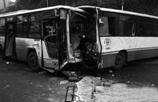
2. (教师出示车祸的图片。)
T: Please look at this picture. How terrible!
What can you see in this picture?
Ss: I can see two broken buses./I can see a bus hits another bus.
T: What happened to them? They have an…
(教师边说边板书。)
|
accident |
T: Now, in this class, we’ll learn about an accident.
(过渡到新课内容。)
Step 2 Presentation 第二步 呈现(时间: 10分钟)
呈现1a,并完成1b和1c。
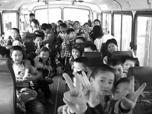
1. (教师出示载有乘客的公共汽车的图片。)
T: Please look at this picture. What can you see in it?
Ss: …
T: Where are they?
Ss: …
T: Yes. They are on a bus. So we call them… Picture 2
(教师边说边板书。)
|
passenger |
2. (教师表演不小心撞在桌上这一动作。)
T: I hit the desk just now. Boys and girls, do you know the meaning of “hit”?
S1: …
S2: …
 …
…
T: You’re quite right! If a car hits another car, what will happen?
(这一提问为呈现新动作铺垫。)
(板书并讲解。)
|
a traffic accident 一场交通事故 obey the traffic rules 遵守交通规则 |
Ss:There will be a car accident. Picture 1
T: Very good! In this section, we’ll learn an accident. If people obey the traffic rules, there will be fewer accidents. So we all should obey the traffic rules.
(过渡到新课内容。)
 (方案二)
(方案二)
湖北省互联网违法和不良信息举报平台 | 网上有害信息举报专区 | 电信诈骗举报专区 | 涉历史虚无主义有害信息举报专区 | 涉企侵权举报专区
违法和不良信息举报电话:027-86699610 举报邮箱:58377363@163.com