
2. (引入语法“直接引语”和“间接引语”。要求学生根据1a回答教师的问题。)
T: What did Kangkang say?
(要求学生每人回答一个句子。)
S1: I’ve been there before.
T: So Kangkang said that he had been there before.
(板书画线部分)
T: What did Kangkang say? Next.
S2: It’s a beautiful place with flowers and grass.
T: So Kangkang said that it was a beautiful place with flowers and grass.
(板书画线部分并与上句从句部分对齐。)
T: What did Kangkang say? Next.
S3: The air is fresh and the water…
T: So Kangkang said that the air was … and … was …, and they would see …
(板书画线部分,并与上两句从句部分对齐。然后要求学生将板书与原句对比找出不同之处,老师引导和补充。学习“直接引语”和“间接引语”。)
1. (要求学生在限定时间内,根据黑板上的提示词复述对话。)
T: Try to use the key words on the blackboard to retell 1a.
Example:
In the past, West Hill was a beautiful place with flowers and grass. We could see bees and butterflies dancing. The air was fresh, the water was very clean and we could see fish swimming. But now, all the flowers, grass, bees, butterflies and fish have gone. The water is so dirty and it smells terrible. Why? Because there are several chemical factories pouring waste water into the streams. So we should protect the environment.
3. (回答问题并核对答案。教师将1a的关键词写到小黑板上。)
|
beautiful-fresh-clean-gone-dirty-terrible-waste
water |
Step 3 Consolidation 第三步 巩固(时间:15分钟)
2. (要求学生不看书,只听录音,捕捉要点,回答问题,提高听力水平。)
T: Close your books. Listen to the tape carefully, then answer these questions.
(学生根据黑板上所提出的问题,听录音1a。)
|
(1)Can you say something about West Hill in the past? (2)What did they see on the West Hill two days later? |
Step 1 Review 第一步 复习(时间:2分钟)
1. (通过对第一单元的复习,导入被污染的西山景象,用课本中的图画来引出新词汇。)
T: Last unit, we have learned some changes in our hometown. Can you say some?
S1: The roads are wider.
S2: The buildings are higher and higher.
S3: The living conditions have improved…
S4: …
T: Yes. Many changes have happened in our hometown. Let’s look at the two pictures about West Hill.
Step 2 Presentation 第二步 呈现(时间:15分钟)
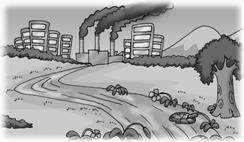
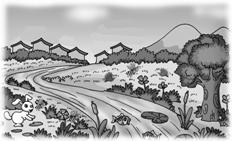
T: Are there any differences between them?
Ss: Yes.
T: Let’s look at Picture 1. What can you see on West Hill in the past?
S5: I can see some flowers and grass.
S6: I can see a butterfly dancing.
T: Yes, there is a butterfly dancing.
(板书并讲解)
|
there is/are … doing sth. |
T: What else can you see?
S7: I can see a rabbit.
S8: I can see some houses.
S9: …
T: (指着一蜜蜂)What’s it?
Ss: 蜜蜂。
T: It’s a bee. There is a bee flying.
(板书并讲解且要求掌握。)
|
bee |
T: (指着小溪) What’s it?
Ss: 小河。
T: It’s a stream. And there are some fishes swimming in the stream.
(教师板书并讲解stream且要求掌握。)
|
stream |
T: We knew West Hill was a beautiful place. Look at Picture 2. Oh, my goodness! What has happened to West Hill?
(板书并讲解my goodness且要求掌握)
|
my goodness |
T: What changes can you find?
S10: The rabbit has disappeared.
S11: The fish have died.
S12: The trees have died.
S13: There are no flowers, butterflies, grass and so on.
S14: There are some factories.
T: (手指着工厂)Yes, there are several factories. They are chemical factories.
(教师板书并讲解several和chemical,且要求掌握several。)
|
several chemical |
T: (指着工厂冒的黑烟并捂住鼻子做呼吸困难状) They are making much smoke. It can cause breathing problems.
(板书并讲解,且要求掌握。)
|
breathe |
T: (指着排放的废物)And they are pouring waste water into the streams.
(板书并讲解且要求掌握waste。)
|
waste pour …into … |
T: From Picture 2, we know the chemical factories are harmful to the animals and plants.
(板书并讲解。)
|
harmful |
录音机/图片/小黑板
3. Learn about different kinds of pollution:
(1) Air pollution makes people sick.
(2) Light pollution is harmful to our eyes.
(3) Litter influences the look of our cities.
2. Learn direct speech and indirect speech.
Kangkang said that it was a beautiful place with flowers and grass.
1. Learn some new words and expression:
bee, my goodness, several, waste, stream, breathe, influence
3. Homework:
T: Please write an article. The title is“My Ideal School”or“My Ideal City”.
板书设计:
|
Pollution
causes too many problems. Section C  a kind of be
harmful to … a kind of be
harmful to …go deaf do harm to … all sorts of …=all kinds of … Making a loud noise in public is also a kind of pollution. |
湖北省互联网违法和不良信息举报平台 | 网上有害信息举报专区 | 电信诈骗举报专区 | 涉历史虚无主义有害信息举报专区 | 涉企侵权举报专区
违法和不良信息举报电话:027-86699610 举报邮箱:58377363@163.com