
1. (通过第四步的练习,教师示例,让学生分组讨论下面的问题。)
(1)T: Make a survey. What kinds of pollution are there in your town / village? And discuss how the pollution affect the environment in groups. Then fill out the table below.
(2)T: Interview one of your classmates like this.
T: Is there any pollution around you?
S1: Yes, there is.
T: What is it?
S1: Air pollution.
T: What does it cause?
S1: It’s difficult for us to breathe.
T: How can we deal with it?
S1: Pull down the factories.
|
Kinds of pollution |
Effects
on our environment or health |
Solutions |
|
|
|
|
|
|
|
|
|
|
|
|
|
|
|
|
|
|
|
|
(板书并讲解effects on our environment)
3. (在小黑板上准备一些有关直接引语和间接引语转换的练习题,两分钟内完成。)
Step 5 Project 第五步 综合探究活动(时间:5分钟)
2. (复习2a)
T: Because of the pollution on West Hill, a journalist interviewed Granny. What did the journalist ask Granny? Do you still remember?
Ss: Yes.
S1: He asked Granny if …
T: What was Granny’s answer?
S2: She said that …/She told the journalist …
(继续上面的问答,来练习2a的句子。)
1. (教师通过复习西山的污染来练习2b的句子。)
T: (教师出示Section A,1a中的第二幅图)
What can you find in the picture?
(让学生用所学知识发现污染,为做环保人作铺垫。)
S1: There is water pollution. BThe fish has gone.
S2: There are several chemical factories pouring waste water into the river.
S3: There is noise pollution. Granny can’t sleep well.
S4: …
T: Oh, my goodness! Does Kangkang still want to have the picnic there?
Ss: Of course not.
T: Does Granny still want to live there?
Ss: No, she will manage to leave there.
(复习2b)
T: Now let’s listen to the tape of 2b, and read after it.
(教师讲解并强调这些功能用语。)
2. (让学生分小组讨论。)
T: There’re so many kinds of pollution around us. How can we deal with them? Discuss in groups of four.
S1: Pull down the polluting factories.
S2: Make some rules to stop pollution.
S3: Throw the rubbish into the dustbin.
S4: …
(教师总结后。)
T: Let’s try our best to be greener people, OK?
Ss: OK!
Step 4 Practice 第四步 练习(时间:15分钟)
2. T: From the pictures, we know pollution is bad for our health in many ways. If there is no pollution on the earth, what will the earth be like?
(板书并讲解in many ways)
Ss: Maybe our earth will be greener and more beautiful.
T: Yes. We should protect our planet from now on. OK , let’s read 1a and fill in the blanks with the words and phrases above.
(学生用所给的单词和短语填空,老师与学生核对答案。)
1. T: Noise pollution is harmful to people. But it’s not the only one in our world. Do you know any other kinds of pollution?
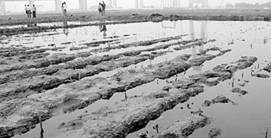 SS: Air pollution, soil pollution, water pollution,
light pollution, litter and so on.
SS: Air pollution, soil pollution, water pollution,
light pollution, litter and so on.
(教师展示图片一。)
T: What kind of pollution is it?
Ss: Soil pollution.
T: That’s right. What causes soil pollution?
S1: People use too many chemicals in their fields.
T: So they destroy the soil. (教师板书destroy并释义。)
|
destroy |
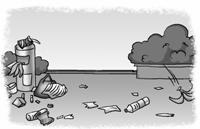 (教师展示图片二。)
T: Look at this picture. What kind of pollution is it?
Ss: Litter.
T: Yes. There’s a pile of rubbish here. It makes our environment dirty.
(教师板书并讲解rubbish并要求掌握。)
|
rubbish |
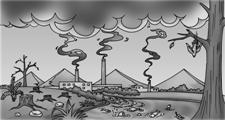
T: (指着图片的浓烟)What kind of pollution is it?
Ss: Air pollution.
T: Yes. What creates air pollution?
(板书并讲解,且要求掌握。)
|
create |
Ss: Burning coal.
T: With the development of industry, air pollution is becoming more and more serious.
(板书并讲解,且要求掌握industry。)
|
industry |
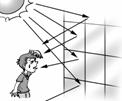

T: Look at the picture. Which kind of pollution is it?
S3: Light pollution.
T: Yes. Look at the strong, changeable light. It’s bad for eyes.
Step 1 Review 第一步 复习(时间:5分钟)
1. (复习噪音污染,导入词汇教学。)
T: Is noise a kind of pollution?
Ss: Yes.
T: What can cause noise pollution?
S1: The machines in some factories.
S2: Planes.
S3: Loud pop music.
S4: Cars.
S5: The traffic.
S6: …
T: Many things making loud noise can cause noise pollution. What problems does noise pollution cause?
S7: Noise pollution can cause hearing loss.
S8: It makes people sick or become deaf.
S9: It also makes people’s lives uncomfortable and unpleasant.
T: Yes, loud noise can cause high blood pressure as well.
(教师板书新词并释义,且要求掌握blood,理解pressure。)
|
high
blood pressure |
Step 2 Presentation 第二步 呈现(时间:15分钟)
湖北省互联网违法和不良信息举报平台 | 网上有害信息举报专区 | 电信诈骗举报专区 | 涉历史虚无主义有害信息举报专区 | 涉企侵权举报专区
违法和不良信息举报电话:027-86699610 举报邮箱:58377363@163.com