
2. (让学生根据调查表进行报告。)
T: Please report your work to the class.
S5: …
方案二:
(小组活动,四人一组,引导学生讨论并思考他们身边实际存在的各种类型的污染及其危害,并由一名小组成员书面记录整理,最终以书信的形式将问题反映到报社。完成2。)
T: Work in groups of four, think about what kinds of pollution we have in our hometown and discuss the bad effects caused by them. Write them down and after school mail it to the newspaper agency.
1. (通过本节课的学习,让学生认识到噪音污染的来源及其危害,通过学生的小组活动,调查各种各样的噪音污染以及怎样更加有效地加以改进。)
T: Make a survey in groups about the noise pollution. Before you do it, I’d like to say
something about noise pollution in our school, in my home and my neighborhoods.
(通过教师的示范作用,使此练习变得更加容易。)
T: In our school there is noise pollution everywhere … And in my home, my son likes NBA
games. He often watches it loudly… And in some public places, people speak loudly…
Discuss in groups and fill out the form.
|
Place Name |
At
school |
At home |
In other
public places |
|
S1 |
|
|
|
|
S2 |
|
|
|
|
S3 |
|
|
|
4. (抽查)
Step 4 Practice 第四步 练习(时间:10分钟)
(教师用课文中的噪声污染来启发学生找出周围的噪声污染。)
T: We have learnt noise is a kind of pollution. What causes noise pollution around us?
(让学生分组讨论,教师给学生一些引导,让学生说出我们身边的噪声污染。)
S1: The students in the next room are singing.
S2: Some students are talking loudly in the classroom.
S3: Someone is typing the keyboard strongly.
S4: Some people answer the telephone call aloud.
S5: …
(教师在列出噪声污染的各种来源后,教导学生如何避免出现这些现象。从而培养学生的环境保护意识。)
T: Everyone knows noise pollution is harmful to our ears. But how can we solve these problems?
S6: Speak to each other in a low voice.
S7: Try to find a proper place to answer the telephone.
S8: Type the keyboard softly.
S9: Find a proper place and proper time to enjoy music.
S10: …
Step 5 Project 第五步 综合探究活动(时间:5分钟)
方案一:
3. (要求学生利用小黑板上的关键词复述1a。)
T: Retell the passage with the key words given. Three minutes for preparation.
a. noise
b. go deaf
c. print/living near airport/no better than/in public/cars and machines
d. uncomfortable and unpleasant
e. trying to solve
2. (让学生两人一组读课文,讨论1c的四个句子应该分别放在课文中的哪一段。)
T: Read the passage again, and look at the four sentences in 1c. S1, please read the four sentences.
S1: …
T: Which paragraph should they belong to?
(教师与学生核对答案,让学生回答选出正确答案的理由。)
1. (根据课文内容,完成1b的练习。)
T: OK. Read 1a again and finish 1b by yourselves.
(教师与学生核对答案。)
6. (核对答案后)
T: What are the bad effects caused by noise pollution?
(板书并解释)
|
effect |
Ss: It makes people…
T: Are there any countries trying to solve the environmental problems?
Ss: Yes, there are.
Step 3 Consolidation 第三步 巩固(时间:8分钟)
5. T: Read the passage, then write down these five kinds of noise pollution in the passage.
4. T: So noise pollution is harmful to humans’ health. Right?
Ss: Yes.
T: OK. Let’s listen to the passage in 1a. Try to find out how many kinds of noise pollution are mentioned in the passage.
(开始播放录音,播放完核对答案。)
3. T: You know, playing loud rock music at midnight is a kind of pollution.
(板书解释并要求掌握)
|
a
kind of |
T: Why?
Ss: Because playing loud rock music can make lots of noise.
T: Yes. It not only disturbs others but also does great harm to hearing.
(板书,领读并讲解disturb,要求掌握。)
|
disturb do harm to=be harmful to |
T: Let’s look at the picture.
(教师展示图片三。)

T: (指图片问。) What are they doing?
Ss: They are printing newspapers. (教师帮助回答并释义,领读print且要求掌握。)
T: The machines are making loud noise. Can they hear each other clearly?
Ss:No.
T: They have to say the words again and again. If they work there for a long time, they may go deaf. (教师指着耳朵领读go deaf并解释deaf: unable to hear,且要求掌握。)
T: That is to say, they will have hearing loss.
(板书,并要求掌握)
|
hearing loss |
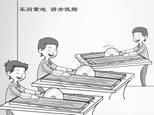 (教师展示图片四。)
T: (教师指着图片。) They are working in the sawmill. And it also makes loud noise. It may disturb the people nearby. They can’t sleep well.
(板书并解释)
|
sawmill nearby |
湖北省互联网违法和不良信息举报平台 | 网上有害信息举报专区 | 电信诈骗举报专区 | 涉历史虚无主义有害信息举报专区 | 涉企侵权举报专区
违法和不良信息举报电话:027-86699610 举报邮箱:58377363@163.com