
|
技能目标 Skill Goals ▲Talk about advertising and advertisements ▲Practise making complaints and expressing emotions ▲Practise expressing and evaluating different views ▲Review the Object Complement ▲Write an advertisement |
3. Learning ability goals学能目标
Learn how to describe plants (properties; places of birth; what they are used for; how to grow and take care of them, etc).
Teaching important points 教学重点
Help students learn to describe plants and how to grow and take care of them.
Teaching difficult points 教学难点
How to help students learn more about “botany”, and then give descriptions.
Teaching methods 教学方法
Discussion
Pairwork/ Groupwork
Teaching aids 教具准备
Pictures, slides, a PC and a projector.
Teaching procedures & ways 教学过程与方式
Step I Revision
T: In the last unit, we’ve learned a lot about Australia. Now who’d like to make a general speech on the country?
S: Let me try. Australia is the only country in the world which covers an entire continent. It is a wealthy country, which produces metals, precious stones, coal, grain, meat and wines, and has the biggest iron mines in the world. Australia has about one-sixth of the world’s sheep and produces almost one-third of its wool. The climate in Australia varies from north to south.
T: Anything else?
S: Modern Australia is made up of six states and two territories. The first Australians were the aborigines and Torres Strait Islanders. The two world wars had a strong influence on Australia. The official language is English, which are quite different from British and American English.
Step II Warming Up
T: Good. You really did a great job. Do you know what is the national flower of Australia?
S: Golden Wattle (Acacia pycnantha)(金合欢,又称相思树).
Show the picture to students.
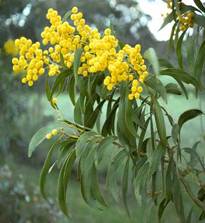
T: Very good. As shown in the picture, the species is certainly attractive with its showy, large, bright golden flower heads. Now look at the pictures on Page 28 in our textbooks. These are four flowers commonly seen in our daily life. First, match each flower with its correct name, please.
T: There seems no difficulty for you to do this, right? OK, the answer is…
S: ①-rose; ②-tulip; ③-peony; ④-sunflower
T: Well done. Susan, what is your favorite? Why?
S: I love sunflower best of all. There are, I think, three reasons,: first, I love eating the seeds of sunflowers, they are delicious; second, their stems can be used to build fences by farmers; third, sunflower oil is very popular in daily life.
T: Great. Lily, can you tell us something about the other three flowers?
S: OK. Tulips are native to Central and Western Asia, and parts of the Middle East, roughly in the region near Afghanistan. Tulips are mainly used for decoration. Tree peony, the Chinese National Flower, native to China, is called as the "King of flowers", which is widely used in Chinese medicine. Rose is native to Southwest Asia, and it is often used as present with the meaning of “love”. Also, rose flower is a kind of important Chinese medicine.
T: Good. As we all know, flowers are only one of the most important parts of plants. Plants are very important to human beings. They provide us food, medicine, decoration, etc. Without them, our world would be dull, lifeless… And growing plants can be both fun and a useful experience. Do you have such experiences? Do you know how to grow certain plants? And how to take care of them? The pictures on Page 29 is an example of planting soybeans. Now everyone, look at the pictures first, then try to explain the stages of growing soybean and how to take of them by describing each picture, you may write down your ideas on the paper.
Move around the class and check their work. Offer language help if needed.
Step III Speaking about procedures
T: Kate, would you like to show us your ideas?
S: Glad to. First, put some soft soil in the pot or box; second, put the seeds of soybeans on a wet cloth or put them in the water; then, put the seeds into the soil. After several days, the seeds come into bud and out of the soil. Later on, water them every two days till the green leaves grow.
For this step, the teacher can (or ask the students to ) make a short film to present the stages of growing soybeans.
Step IV Discussion
T: Well done, Kate. Soybeans are easy to grow. Now imagine you want to plant something else in your garden plot, work in groups and decide which plants, vegetables or flowers your group would grow, how to plant them, how to take care of them, when to harvest or pick them.
Step V Oral-presentation
Ask several students to show their answers to the class.
Sample answers:
Carrots are loaded with vitamins, and are nutritious. On top of being good for you, carrots taste good, too. So our choice is carrot.
(1) Before planting, work the soil deeply.
(2) Sow them very thinly, about 1/4 inch deep. Cover them with a fine garden soil. Or sprinkle them on top of the soil, and lightly water them into the soil.
(3) Keep carrots well weeded early in the season. They are easily overcrowded, with any competing weeds usually winning out.
(4) Begin to harvest carrots as “baby” size, thinning the row as you harvest. Once you begin picking, you can harvest as needed.
Step VI Talking
T: Really interesting. But how do the plants grow?
Read the instruction on Page 170 in the WORKBOOK to the students, then ask the students to work in pairs to describe “the process of photosynthesis of plants” in their own language.
A description of basic photosynthesis:
Photosynthes is the process by which green plants and certain other organisms transform light energy into chemical energy. During photosynthesis in green plants, light energy is captured and used to convert water, carbon dioxide, and minerals into oxygen and energy-rich organic compounds.
Step VII Assignment
T: In this class, we’ve learned a lot about plants and planting. Ask your parents or others to teach you more about planting, if you are interested in. And please do Exercise 3 on Page 30 in the textbooks
2. Ability goals 能力目标
Enable students to talk about “botany” (including the names, the properties, the usage of certain plants, how to grow and take care of them, etc) and to say something about it.
The First Period Speaking
Teaching goals 教学目标
1. Target language目标语言
a. 重点词汇和短语
tulip, rose, peony, strawberry, bunch,
b. 重点句子
Can you tell something about each flower?
Where does it come from?
What is it used for?
Which flower is your favorite?
Explain how to grow and take care of the soybean plant.
Describe what to do and how to take care of the flowers you have been given.
3. 课型设计与课时分配
1st Period Speaking
2nd Period Reading
3rd Period Language Study
4th Period Listening
5th Period Extensive reading
6th Period Writing
2.5将INTEGRATING SKILL之WRITING 部分与WORKBOOK中WRITING部分整合在一起上一节“写作课”。
2.4将INTEGRATING SKILL中READING部分与WORKBOOK中READING部分整合在一起上一节“泛读课”。
2.3将课本LISTENING部分和WORKBOOK中LISTENING部分整合在一起上一节“听力课”。
2.3 将课本LANGUAGE STUDY部分与WORKBOOK中PRACTICIGN部分整合在一起上一节“语言知识”课。
2.2 将课本PRE-READING部分、READING 部分和POST-READING部分以及WORKBOOK中GRAMMAR部分第1题整合在一起上一节“精读课”。
湖北省互联网违法和不良信息举报平台 | 网上有害信息举报专区 | 电信诈骗举报专区 | 涉历史虚无主义有害信息举报专区 | 涉企侵权举报专区
违法和不良信息举报电话:027-86699610 举报邮箱:58377363@163.com