
1. (教师播放听力1录音,让学生回答小黑板上的问题。)
(出示小黑板)
|
(1) What was Tom doing at about nine o’clock last
night? (2) What was Alice doing then? (3) What was David doing then? |
(核对答案。)
(让学生再听1,填充1中的表格。)
T: Now listen again and fill out the table in 1.
(核对答案,完成1。)
5. (猜动作,巩固when,while引导的时间状语从句。假设两位同学上周日是一起度过的,让他们表演,展示上周日一位同学在做某事的时候,另外一位同学在干什么。让其他同学来猜测。)
(S1表演打篮球,S2表演玩电脑游戏的动作。)
S3: S1 was playing basketball while S2 was playing computer games.
(换两个学生表演,换其他同学猜。)
Step 2 Presentation 第二步 呈现(时间:8分钟)
T: Well, we were doing different things at different times in the past. What were Tom, Alice and David doing at about nine o’clock last night? Listen to 1 and we will know the answer.
4.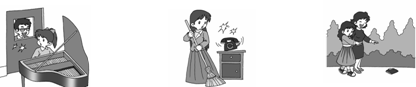 (再次呈现图片或课件,练习由when与while引导的时间状语从句。)
 Picture 1
Picture 2
Picture 3
Picture 1
Picture 2
Picture 3
Picture 4 Picture 5 Picture 6
T: Look at Picture 1 and write a sentence with Past Continuous Tense. For example: Jane was playing the piano when her father knocked at the door.
(板书)
|
Jane was playing the piano when her father knocked
at the door. |
T: Now, please write sentences following the example.
(让五名学生到黑板上按图各写一个句子,其余学生在纸上写。教师在教室内走动,检查学生写句子的情况,然后大家一起检查黑板上的句子。对有错误的及时纠正。)
3. (联系学生实际,练习过去进行时。)
T: S1, what were you doing at five o’clock yesterday afternoon?
S1: I was …
…
2. (展示图片,对过去进行时进行练习。)
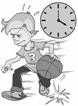
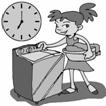
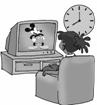
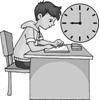
Picture 1 Picture 2 Picture 3 Picture 4
(教师示范Picture 1。)
T: What was she doing at seven o’clock last Sunday morning?
S1: She was washing.
(板书)
|
She was
washing. |
(学生两人一组操练Picture 2-4。)
S2: What was he doing at nine o’clock last Sunday morning?
S3: He was doing his homework.
S4: What was he doing at four o’clock last Sunday afternoon?
S5: He was playing basketball.
S6: What was she doing at eight o’clock last Sunday evening?
S7: She was watching TV.
(老师在S3, S5, S7回答时,板书答语,并用彩色粉笔在过去进行时下面画线,让学生加深对其结构的理解。)
|
She was
washing. He was doing his homework. He was playing basketball. She was watching TV. |
Step 1 Review 第一步 复习(时间:12分钟)
1. (快速反应,运用表示同意和不同意的句型。)
(教师可以运用教室内的物品,也可以是某个同学或某个明星。)
T: Hello, everyone. Nice to see you all.
Ss: Nice to see you, too.
T: It’s sunny today and we are very happy. Do you think so?
Ss: Yes, we agree with you./we think so.
T: You have grown up and everyone has his/her own opinions about something or somebody. Let’s talk about them with the expressions of disagreement and agreement.
(教师示范:)
T: S1,(指着教室内标语)the handwriting is very nice, right?
S1: I think so./I agree.
T: S2,(指着一个高个子学生) S3 is very short?
S2: I don’t agree./I don’t think so.
(找几组学生,反复练习此活动。)
T: Good job. What were you doing just now?
Ss: We were talking about something or somebody to express our own opinions.
T: Here are some pictures. Look at these pictures and say out what they were doing last Sunday.
录音机/小黑板/图片/课件
3. Review Past Continuous Tense:
(1) What was he/she doing at about nine o’clock last night?
(2) My mother was doing the dishes and my father was reading the newspaper.
2. Review agreement and disagreement:
(1) I think so./I agree./I agree with you.
(2) I don’t agree./I don’t think so./I think they are just so-so.
1. Learn a new word:
dish
湖北省互联网违法和不良信息举报平台 | 网上有害信息举报专区 | 电信诈骗举报专区 | 涉历史虚无主义有害信息举报专区 | 涉企侵权举报专区
违法和不良信息举报电话:027-86699610 举报邮箱:58377363@163.com